


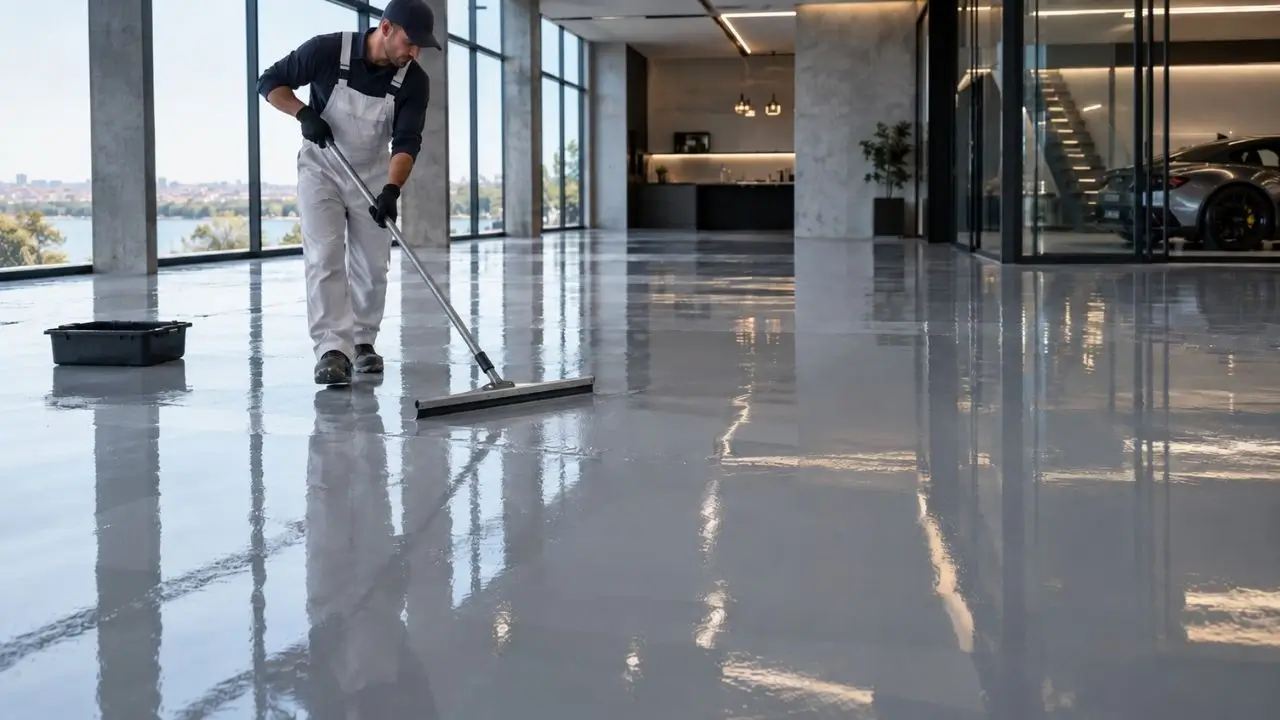
If you are tired of the cold and dusty nature of concrete floors, epoxy coatings offer the exact transformation story you are looking for. This material is not just an ordinary layer of paint, but a monolithic floor shield hardened through a chemical reaction. It has a wide range of uses, extending from factory corridors to luxury showrooms.
Choosing the right system depends directly on the traffic density, chemical exposure, and your budget for the space. The wrong resin choice can lead to blistering or cracking in a short time. Therefore, it is essential to closely understand the unique character of each option.
What Are the Types of Epoxy Flooring?
1. Multilayer Epoxy Coating

The multilayer system is woven with overlapping resin layers to withstand heavy loads and intense forklift traffic. Thanks to its thickness, it defies impacts and absorbs mechanical stress. During the application phase, quartz sand or silica is added to maximize slip resistance. Factory workshops and production facilities highly value this durable structure.
At this point, product choice is of great importance. Dryfix DFC 310 is a two-component, solvent-free epoxy resin-based topcoat. It is designed to create a non-slip, smooth, and durable surface on industrial floors. It offers a practical solution thanks to its easy application. It is preferred in industrial areas, on floors, or walls. DFC 310 provides long-lasting aesthetics with its excellent adhesion, chemical resistance, and abrasion resistance.
Even the slightest roughness on the floor surface is hidden in this multilayer application. The deep penetration of the resin into the sub-layers reduces the risk of peeling to zero for many years. Following a professional application, the surface gains a strength that will defy even the harshest industrial conditions.
2. Self-Leveling Epoxy Coating
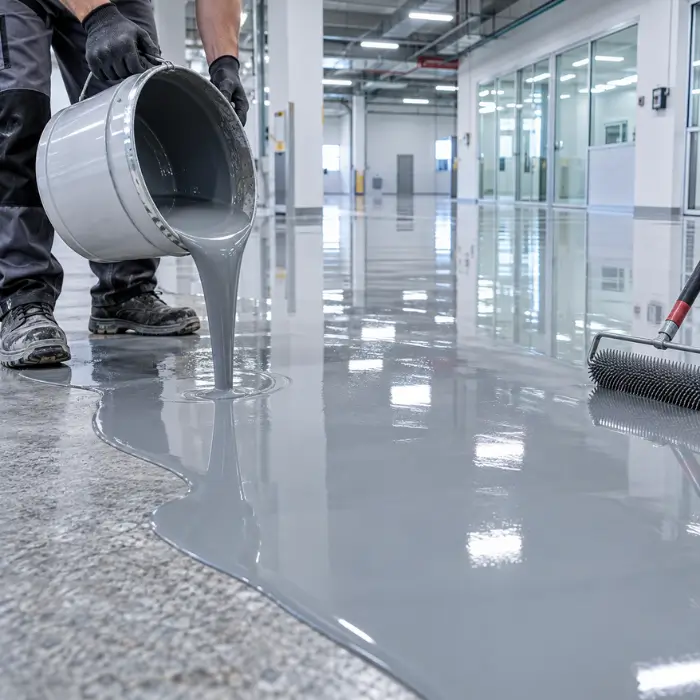
If you are looking for a mirror-shine, smooth, and seamless surface, self-leveling systems are perfect for you. Thanks to its fluid consistency, it creates a flawless level on its own in the poured area. Its dust-repellent structure is an indispensable advantage for hospitals and laboratories requiring a sterile environment. Cleaning processes are extremely effortless on this smooth floor.
Its application areas are quite broad. Epoxy Self Leveling Topcoat DFC – 300 is used on all kinds of industrial floors, warehouses, stores, parking lots, and hospitals. Its mechanical strength and abrasion resistance are high. It is easy to clean. It can also be utilized as a paint layer in the final coat of a multilayer system.
Visually, it creates a flawless sense of depth. Since its light reflection capacity is high, it also lowers the lighting costs of indoor spaces. That smooth fluidity felt while walking on the floor directly elevates the overall quality of the space.
3. Orange Peel Textured Epoxy Coating
Textured coatings, developed to eliminate the risks created by slippery floors, leave a slightly rough texture on the surface. The orange peel appearance, from which it takes its name, displays an aesthetic stance while also increasing pedestrian safety. Parking ramps or wet-volume production areas prioritize this textured structure.
One of the prominent solutions in this category is as follows: Epoxy-Based Orange Peel Textured Topcoat DFC – 400 is used on all kinds of industrial floors, warehouses, stores, parking lots, and hospitals. Its mechanical strength and abrasion resistance are high. It is easy to clean.
Its patterned structure successfully camouflages minor tonal differences or micro-defects in the substrate. Its resistance to long-term foot traffic is quite high, keeping signs of wear to a minimum. Increasing the friction coefficient plays a critical role in preventing occupational accidents.
4. 3D Epoxy Flooring
For those who want to step away from the ordinary in bathrooms, hotel lobbies, or personal offices, three-dimensional floors are practically a work of art. It is achieved by coating high-resolution visuals with a transparent epoxy layer. It creates optical illusions that make you feel like you are swimming in the sea or standing on the edge of a cliff when you look at the floor.
This system, which takes depth perception to its peak, completely changes the atmosphere of the space. The application process requires high precision and mastery. The slightest air bubble or dust particle can ruin the magic of the visual. Therefore, the concrete moisture rate and floor smoothness are meticulously checked during the preparation phase.
In addition to offering a visual feast, it does not compromise on chemical resistance. Its cleaning is extremely practical, and it manages to preserve its first-day vibrancy for years. This innovative approach, which fascinates everyone who steps into the space, is a favorite among those pushing the boundaries in architectural designs.
5. Clear Epoxy Coating
When you want to preserve the raw texture of concrete or display custom-designed logos and stones, clear epoxy coatings come into play. With its colorless and glossy structure, it shows the underlying details in crystal clarity. It finds a place for itself in a wide area ranging from industrial facilities to stylish cafe designs.
Thanks to its ability to refract light, it makes the space look wider and more spacious than it is. It provides surface protection while preventing the natural color from fading. Its scratch-resistant formula ensures it does not lose its shine even in high-traffic areas.
Choosing yellowing-resistant formulations during application is essential for long-term performance. The clear resin shaped in professional hands radiates a timeless sense of modernity. It highlights the characteristic cracks or natural veins of the concrete as an aesthetic element.
Which Epoxy Coating Should I Choose?
When choosing the right epoxy coating, you must weigh the function of the area against the physical pressures it will be exposed to. The needs of a warehouse carrying heavy loads and a store where aesthetics are at the forefront are diametrically opposed. The comparison table below will draw a clear path for you during the decision phase:
| Epoxy Type | Most Suitable Areas | Prominent Feature |
| Multilayer | Factories, heavy industry workshops | Maximum impact resistance and multi-layered structure |
| Self-Leveling | Hospitals, laboratories, offices | Smooth, mirror-shine, and easy to clean |
| Orange Peel | Parking lots, ramps, wet floors | Non-slip textured surface and high abrasion resistance |
| 3D | Hotel lobbies, bathrooms, showrooms | Striking visual illusion and aesthetic depth |
| Clear | Architectural projects, decorative areas | Crystal clarity and preservation of raw concrete texture |
When deciding, do not ignore your budget and the condition of the subfloor infrastructure. A professional site inspection will prevent costly surprises later on. Resin thickness, floor preparation, and primer selection are like interconnected links; if one is missing, the entire structure will suffer.