


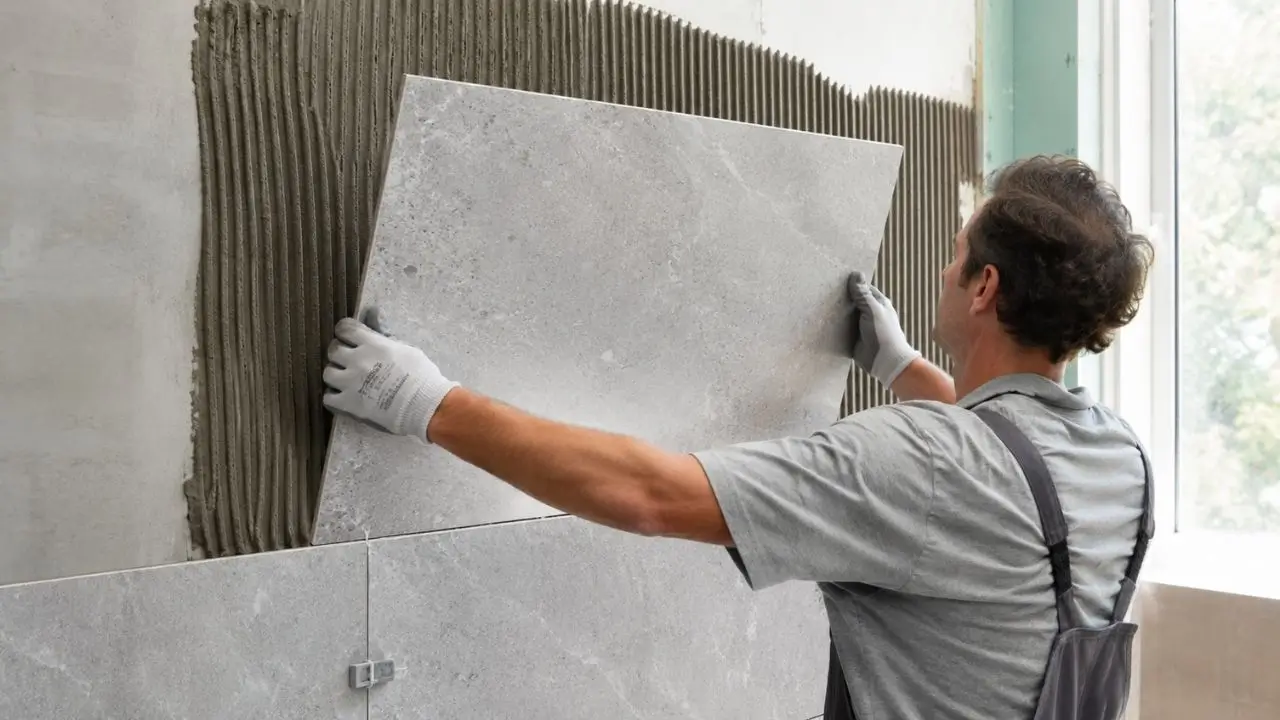
Installing large format tiles has become a dominant trend in modern design, offering a sleek, seamless aesthetic that minimizes grout lines and maximizes visual impact. However, these oversized materials present significant structural challenges that demand highly specialized installation techniques and carefully selected bonding agents. When tiles exceed traditional dimensions, their increased weight and expansive surface area require an adhesive capable of mitigating severe sheer stresses and accommodating microscopic substrate movements. Selecting the wrong bonding agent inevitably leads to catastrophic failures, including hollow spots, extensive cracking, and ultimately, tile detachment. This comprehensive guide explores the critical factors professionals must consider when selecting the optimal adhesive for large format tiles. By understanding polymer modifications, flexibility ratings, and specific substrate requirements, installers can guarantee a durable, flawless finish that withstands time and preserves the integrity of the architectural vision.
Understanding the Unique Demands of Large Format Tiles
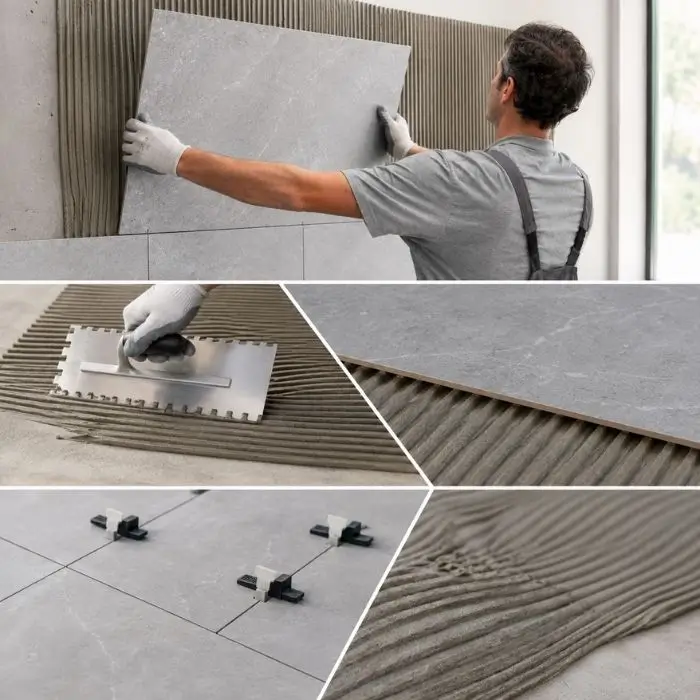
Large format tiles, generally defined as any tile with at least one edge exceeding fifteen inches, behave fundamentally differently than smaller counterparts during installation. Their immense size drastically reduces the number of grout joints across a given surface area, which traditionally act as expansion zones accommodating natural building movement. Consequently, the adhesive bed itself must absorb a significantly higher degree of physical stress, thermal expansion, and mechanical vibration. Furthermore, the sheer weight of these massive ceramic slabs increases the risk of vertical slippage on walls and uneven settling on floors. Installers must prioritize bonding agents specifically engineered with high-yield characteristics to support this heavy load without compressing under pressure. Standard mortars will quickly fail under these demanding conditions, compromising the entire installation and leading to expensive remediation efforts that ruin project timelines and damage professional reputations.
To address these inherent structural challenges successfully, industry professionals must evaluate adhesives based on a specific set of performance criteria tailored to oversized materials. Understanding these requirements is the crucial first step in preventing long-term installation failures. Here are the primary demands that a suitable large format tile adhesive must consistently meet:
- Superior bonding strength: Essential for supporting the extreme weight of large panels without sagging.
- Enhanced flexibility: Crucial for absorbing structural movements and preventing stress-transfers.
- Extended open time: Necessary to allow installers adequate time to maneuver cumbersome tiles into final positions.
- Non-slump properties: Vital for floor installations to ensure heavy tiles do not sink unevenly into the mortar bed.
By securing a product that addresses these specific parameters, contractors establish a secure foundation for flawless execution.
The Importance of Flexibility and Polymer Modification
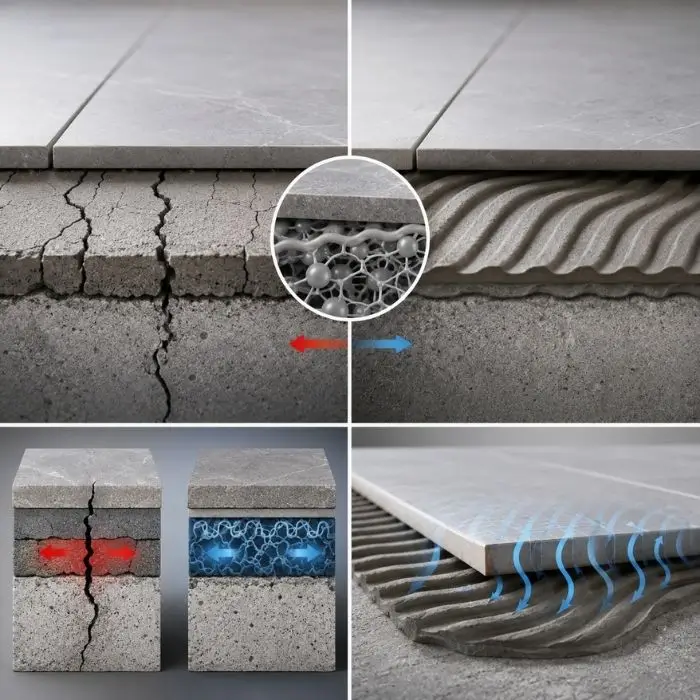
The integration of advanced polymer technologies into modern cementitious adhesives has revolutionized the tile installation industry, particularly regarding large format applications. When dry polymer powders are blended into the mortar, they create a flexible, highly resilient matrix that radically improves the adhesive's physical properties. This modification fundamentally changes how the mortar cures and interacts with both the substrate and tile backing. Traditional unmodified thin-set mortars cure into a rigid, brittle state that easily fractures when exposed to minor structural deflections or temperature fluctuations. In stark contrast, highly polymer-modified adhesives maintain a microscopic elasticity that acts as a vital shock absorber. This flexibility is absolutely critical for massive tiles, preventing the transfer of substrate cracks directly through to the fragile porcelain surface, thereby eliminating one of the most common causes of post-installation tile failure.
When specifying an adhesive for oversized tiles, industry standards dictate the use of highly deformable products, typically classified under specific ISO designations like S1 or S2. An S1 classification indicates a deformable adhesive capable of withstanding moderate substrate movement, making it highly suitable for most standard interior large format installations. Conversely, an S2 classification denotes a highly deformable adhesive engineered for extreme conditions, such as exterior facades, environments subject to intense thermal shock, or challenging substrates like plywood. Investing in a premium polymer-modified adhesive with the appropriate deformability rating guarantees the bonding layer expands and contracts harmoniously with surrounding materials. This dynamic capability prevents the devastating loss of adhesion that ruins otherwise perfectly executed projects. Ultimately, prioritizing advanced polymer formulations over cheaper alternatives represents a vital insurance policy against catastrophic future tile failures.
Evaluating Substrate Compatibility and Preparation
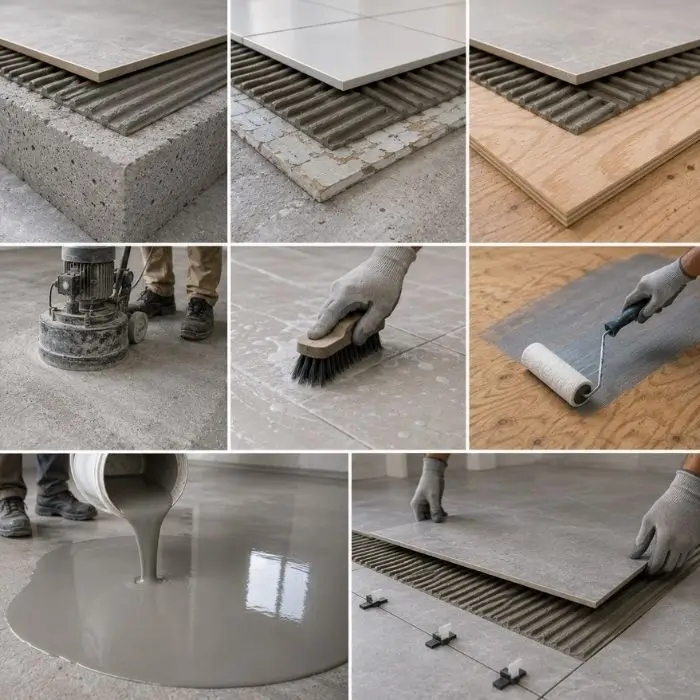
Selecting the perfect adhesive for large format tiles requires a critical assessment of the underlying substrate, as different surfaces demand entirely different bonding strategies. Concrete, existing tile, and wooden subfloors possess unique structural characteristics that directly influence adhesive performance. A highly porous concrete slab might rapidly draw moisture out of the mortar, leading to a weak cure. Conversely, installing over non-porous surfaces like existing porcelain tiles requires an adhesive with exceptionally strong mechanical bonding capabilities, typically achieved through heavy polymer modification. To simplify the decision-making process, professionals must match the adhesive type directly to the substrate material.
| Substrate Type | Recommended Adhesive Level | Essential Preparation Step |
| Cured Concrete | Standard S1 Polymer-Modified | Mechanical scarifying and dust removal |
| Existing Tile | High-Tack S2 Polymer-Modified | Degreasing, abrading, and priming |
| Plywood Subfloor | Highly Deformable S2 Mortar | Ensuring rigidity and applying primer |
Regardless of the specific adhesive chosen, meticulous substrate preparation remains an absolutely non-negotiable requirement for successful large format tile installations. The substrate must be incredibly flat, typically requiring a maximum variance of only one-eighth of an inch over a ten-foot span. Any significant dips or pronounced high spots will immediately cause lippage, a visually jarring condition where adjacent tile edges sit at varying heights. To achieve this mandatory level of flatness, installers frequently rely on premium self-leveling underlayments before even opening a bag of adhesive. Furthermore, the surface must be immaculately clean, completely devoid of dust, grease, or any microscopic contaminants that could act as a bond breaker. Failing to properly prepare the substrate essentially guarantees that even the most expensive polymer-modified adhesive will fail, resulting in compromised structural systems.
Open Time and Setting Characteristics for Heavy Tiles
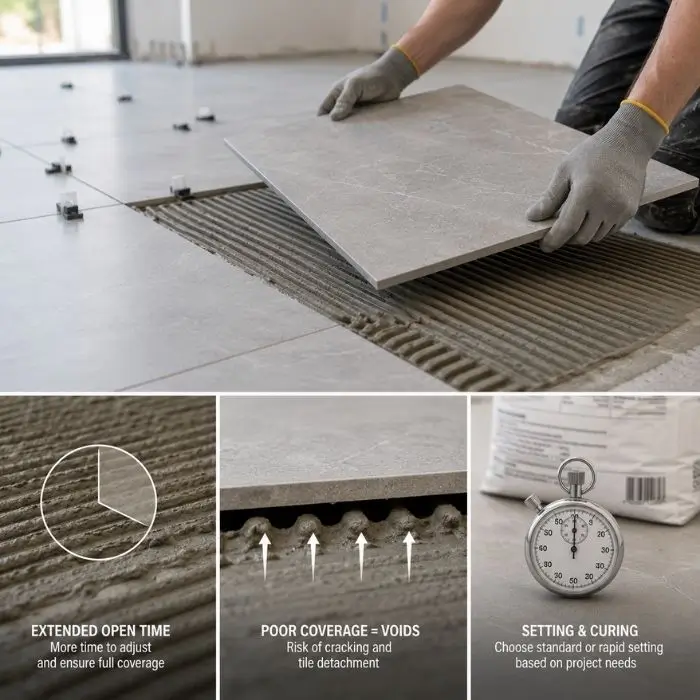
Open time refers directly to the critical window of opportunity an installer has to adjust a tile after the adhesive has been spread before a dry skin begins to form on the mortar. For large format tiles, extended open time is an absolute necessity rather than a mere convenience. These massive pieces are incredibly heavy, cumbersome, and technically difficult to maneuver into their precise final positions. Installers require significantly more time to apply the mortar, position the heavy slab, check for adequate coverage, and make necessary microscopic leveling adjustments. If an adhesive features a short open time, a thin, invisible skin will quickly form over the trowel ridges, drastically reducing the mortar's ability to transfer onto the tile backing. This terrifying scenario creates large voids beneath the tile, ultimately leading to severe cracking and detachment.
Beyond open time, contractors must carefully evaluate the setting characteristics and curing speed of the chosen adhesive, distinguishing between standard-setting and rapid-setting formulations. Standard-setting adhesives generally offer maximum workability and extended open times, making them the preferred choice for massive, complicated installations where precision is paramount. However, rapid-setting adhesives become highly advantageous in colder environments or on commercial projects demanding immediate foot traffic and accelerated completion schedules. These fast-curing formulations aggressively lock heavy tiles into place within hours, preventing accidental shifting during the critical initial curing phase. The chemical mechanism within rapid-setting mortars also physically consumes internal moisture during hydration, which vastly reduces the risk of warping in moisture-sensitive natural stone slabs. Carefully balancing the need for extended workability against timeline demands ensures the selection of an optimal adhesive.
Application Techniques for Maximum Adhesion
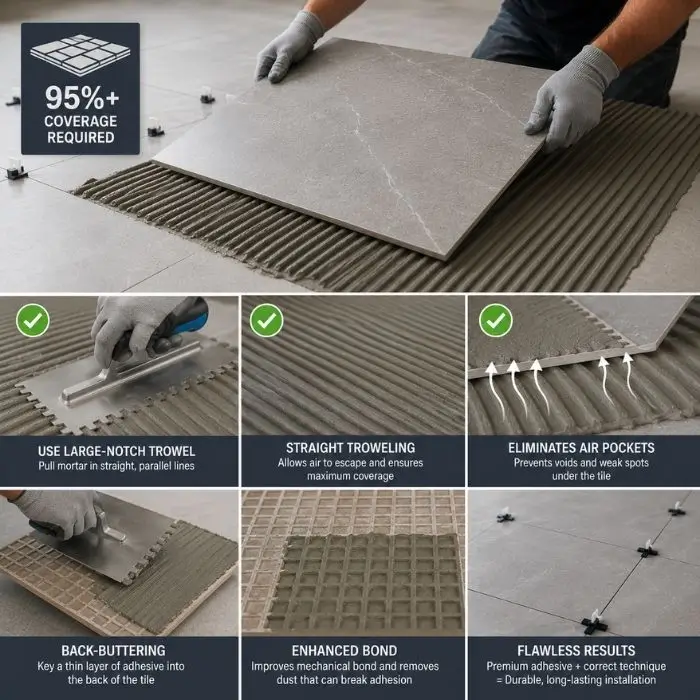
Even the highest quality polymer-modified adhesive will fail catastrophically if applied using incorrect troweling techniques. For large format tiles, achieving a minimum of ninety-five percent mortar coverage across the entire back of the tile is a strictly enforced industry standard. This exceptional level of coverage ensures that the massive weight is uniformly supported, completely eliminating weak voids that cause localized cracking under heavy point loads. To accomplish this, professionals must utilize a specialized large-notch trowel, consistently pulling the mortar in straight, parallel lines rather than chaotic, swirling patterns. Straight troweling allows trapped air to effectively escape from beneath the massive slab when pressure is applied, preventing isolated pockets of structural weakness. This meticulous, directional troweling strategy transforms the adhesive into a comprehensive support system capable of indefinitely sustaining intense pressures.
In conjunction with directional troweling, the mandatory practice of back-buttering remains an essential technique for guaranteeing absolute success with large format installations. Back-buttering involves firmly using the flat side of a trowel to key a thin, even layer of adhesive directly into the porous back of the tile itself before placing it into the combed mortar bed on the substrate. This critical step drastically enhances the microscopic mechanical bond, ensuring that the primary mortar bed firmly integrates with the tile surface. It eliminates the dry, dusty layer often present on factory-fresh ceramics, which frequently acts as a hidden bond breaker. When installers combine premium S1 or S2 classified adhesives with rigorous straight troweling and meticulous back-buttering techniques, they create an impenetrable installation. This professional dedication guarantees perfectly flawless surfaces for decades.
When you demand uncompromising strength and ultimate reliability for your large format projects, Dryfix tile adhesive products deliver the premium polymer-modified performance your professional reputation relies on. Engineered to tackle the toughest substrates and eliminate costly installation failures, our advanced formulations guarantee a flawless, highly deformable bond every single time. Elevate your next installation to absolute perfection and explore the complete range of Dryfix solutions today to secure your architectural vision for decades to come.