


Waterproofing stands out as one of the most critical technical elements that extend the service life of structures and maximize the durability of load-bearing systems against water and moisture. Water acts as one of the greatest natural enemies of buildings; over time, it leads to the rusting of reinforcing rebars within reinforced concrete, the deterioration of structural integrity, and ultimately serious collapses and financial losses. This negative picture not only jeopardizes life safety, but also brings along high-cost repair processes for property owners. Therefore, selecting the correct waterproofing strategies and implementing them flawlessly serves as a vital necessity to protect the value of real estate investments and construct safe living spaces. Within the worlds of engineering and architecture, waterproofing is accepted as a cornerstone of building physics and stands as an intervention area that must never be neglected.
In today's construction sector, numerous distinct insulation materials and application techniques have been developed according to various structural needs, climate conditions, and surface features. During the determination process of the correct method, the annual precipitation amount of the geographic region where the building is located, groundwater levels beneath the foundation, the direction from which water impacts the building, and the geometric features of the application area are meticulously analyzed. Tailored insulation solutions exist for every architectural detail, ranging from foundations to roofs, and basement floors to wet areas. Within this scope, three fundamental methods that have successfully passed engineering tests and proven to provide the highest performance by industry professionals stand out. Surface-based liquid systems, membrane applications, and crystalline penetrating solutions form the most reliable shields in protecting structures against water.
1. Surface-Based (Liquid) Waterproofing

Surface-based waterproofing encompasses polymer or cement-based materials produced in fluid form and applied to the surface in layers using brushes, rollers, or spray machines. While in liquid form, this method deeply penetrates even the smallest capillary cracks and pores of the applied surface, creating a flawless coating layer. After the drying process completes, it transforms into an extremely elastic, jointless, and seamless membrane layer, completely blocking water.
It yields excellent results, particularly on surfaces with detailed and complex geometries, corner junction details, and challenging spots where water can easily leak. On horizontal and vertical floors of wet areas such as balconies, terraces, bathrooms, and kitchens, this technique is preferred as a primary choice. During application, ensuring that the surface is completely clean, dry, free of oil, and moisture-free enables the liquid material to bond flawlessly to the ground.
Applied in successive intersecting layers in this system, the drying duration of each layer must be closely monitored and the technical instructions of the manufacturer must be strictly followed. Acrylic, polyurethane, or cement-acrylic hybrid-based liquid insulation materials possessing exceptionally high crack resistance adapt perfectly to the thermal movements of the building, preserving their protection performance for long years. Thus, moisture infiltration into the structure is completely prevented.
2. Membrane Applications (Bituminous and Synthetic)
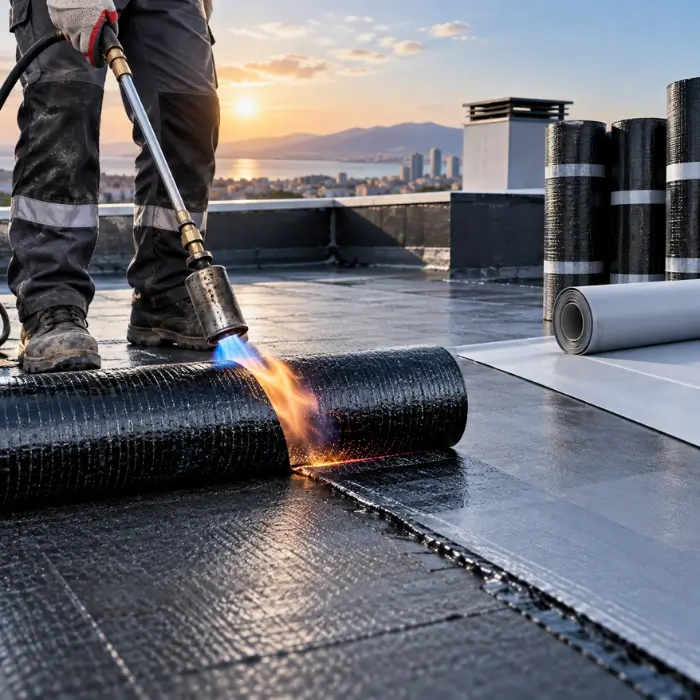
Membrane applications rely on the principle of rolling out and adhering insulation covers supplied in roll form and reinforced with special carrier glass fleece or polyester mats onto the surface. Divided into two main categories as bituminous (elastomeric or plastomeric) and synthetic (PVC, TPO, EPDM), these systems provide superior strength in the insulation of large areas, particularly wide terrace roofs, foundation curtains, viaducts, and water reservoirs.
- Bituminous Membranes: Applied by heating (with a torch) or using cold adhesives; they exhibit high resistance to UV rays, external weather conditions, and mechanical impacts.
- Synthetic PVC Membranes: Thanks to their flexible structures, they display perfect compliance with the structural settlement movements of buildings; they provide light, durable, and long-lasting protection.
- TPO Membranes: They carry eco-friendly features; they possess a high heat reflection capacity and are preferred with confidence in large-scale industrial roof projects.
During application, fusing the joint areas of the covers flawlessly by melting with a torch flame or automatic hot air welding machines carries vital importance. Otherwise, even the smallest joint defect paves the way for water leaks over time. Membrane covers assembled with correct craftsmanship completely safeguard structures against the destructive effects of water for decades.
3. Crystalline (Penetrating) Waterproofing

Crystalline waterproofing is an advanced-level system that forms needle-shaped insoluble crystals within capillary voids by entering a chemical reaction with free lime and moisture inside the concrete. This method does not merely coat the exterior surface of the concrete; it also becomes an inseparable part of the concrete's body. These special crystals, which permanently block the passage of water molecules, remain active as long as the concrete exists and continue to grow over time whenever they contact new moisture.
| Insulation Feature | Technical Description | Structural Advantage |
| Application Direction | Positive and negative surfaces | Full resistance against internal and external pressure |
| Chemical Process | Clogging capillary voids | Self-healing capability over time |
| Material Lifespan | Equivalent to concrete mass | Permanent protection, requires no maintenance |
It stands out as a flawless choice for reinforced concrete structures subjected to high water pressure, such as foundation curtains, retaining walls, elevator pits, water reservoirs, and treatment plants. Saturating the surface with water before application is necessary to ensure the chemical reaction occurs completely. This advanced technology increases the mechanical resistance of concrete while guaranteeing waterproofing for a lifetime.
To permanently protect your structures from the harmful effects of water and achieve maximum performance, you can choose Dryfix innovative waterproofing systems. Manufactured with superior technology, Dryfix products extend the lifespan of your projects by delivering flawless sealing even under the most challenging conditions. Meet Dryfix assurance right now, carry your structures into the future with confidence, and take action immediately to benefit from our expert solutions.