


At the intersection of aesthetics and safety in modern architectural and industrial design, passive fire protection systems play a vital role. Fire safety is not limited merely to detecting and extinguishing flames; rather, it is a complete concept along with preventive measures that delay the spread of fire and maintain structural integrity. Fire-resistant varnishes, which are one of the most critical components of these measures, act as an armor that provides high resistance without spoiling the visual naturalness, especially in the protection of wooden and flammable surfaces. These systems buy valuable minutes in the event of a fire, facilitating evacuation processes and minimizing material losses.
Passive fire protection strategies are mechanisms incorporated during the design phase of a building that fulfill their duties without requiring active intervention. Fire-resistant varnish applications are considered one of the most aesthetic and functional applications of these strategies. Unlike traditional fire-retardant paints, these special chemicals do not cover the texture of the surface; instead, they protect the temperature of the wood, transforming it from a fuel source into a fire-resistant structural element. In the following sections, we will deeply examine all the details, from the working principles of this technology to its certification processes.
1. What is Fire-Resistant Varnish?
Fire-resistant varnish is a specially formulated coating material that raises the ignition temperature of the combustible surfaces it is applied to (usually wood derivatives) and slows down the spreading speed of flames on the surface. Its difference from classic furniture varnishes lies in the special components it contains, which enter into a chemical reaction when exposed to high heat. Thanks to their transparent structures, these products provide protection without spoiling the natural appearance, grain, and color of the wood. Available in both water-based and solvent-based options, these varnishes merge aesthetic concerns with safety requirements in architectural projects into a single pot.
In terms of its basic function, these varnishes create a thin but effective film layer on the surface. However, this layer is not just a physical barrier but also a thermal shield. By preventing the wood from turning into an energy source during a fire, it significantly extends the time it takes for the fire to jump from one room to another. Today, these materials, whose use has become mandatory in museums, hotels, theaters, and highly qualified residential projects, are an integral part of modern building safety.
2. How Does Fire-Resistant Varnish Work?
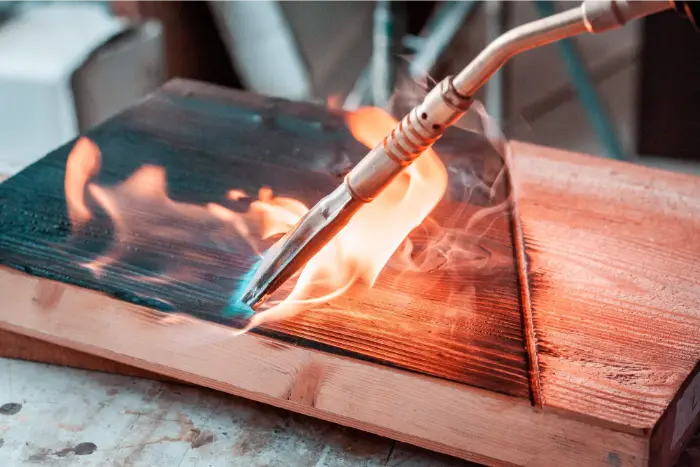
The working principle of fire-resistant varnishes relies on "intumescent" (expanding) technology. This chemical mechanism is activated when the heat reaches a certain critical level. The moment the varnish layer feels the heat, it expands to dozens of times its normal volume, forming a dense, carbonized foam layer. This resulting foam layer acts as a perfect insulation barrier between the flames and the wooden surface.
This process can be summarized in three stages:
- Activation: The chemicals in the varnish react under the influence of heat.
- Foaming and Expansion: A microscopic porous carbon layer that does not conduct heat is formed on the surface.
- Insulation: This carbon layer prevents oxygen from reaching the wood and stops the transfer of heat to the lower layers, delaying the ignition of the structure.
Thus, even if the wood comes into direct contact with the flame, it maintains its internal structural integrity. This retarding effect is generally expressed in periods such as 30, 60, or 90 minutes. This time is of vital importance for the intervention of the fire brigade and the safe evacuation of the occupants.
3. In Which Buildings Should Fire-Resistant Varnish Be Used?
Fire safety regulations mandate compliance with certain standards, especially in mass usage areas. The use of fire-resistant varnishes is not just a preference but a legal obligation in many buildings. These applications are of critical importance, particularly in spaces with intensive wooden construction or where decorative wooden panels are used.
The use of these varnishes is a priority in the following building types:
- Public Buildings and Educational Institutions: Places with heavy human traffic such as schools, universities, and libraries.
- Accommodation and Entertainment Sector: Venues where wooden decoration is prominent, such as hotels, restaurants, theaters, and cinemas.
- Historical Monuments and Museums: Areas where the historical texture must be preserved and the risk of fire is irreparable.
- Transportation Terminals: Wooden ceiling and wall panels in airports and train stations.
These buildings are considered areas with high fire loads. The use of varnish is the most effective passive protection method to prevent a possible disaster. In particular, wooden cladding on escape routes must absolutely undergo this process.
4. Passive Fire Protection Solutions in Industrial Facilities
Industrial facilities are high-risk zones containing flammable chemicals, high-energy lines, and heavy machinery. In these facilities, passive fire protection systems are designed not only to protect human life but also to safeguard millions of dollars worth of equipment and production continuity. Varnishes and coatings used in industrial areas are formulated to withstand much harsher conditions than domestic uses.
The following table compares the functions of passive fire protection components in industrial facilities:
| Solution Type | Application Area | Main Purpose |
| Fire Retardant Varnish | Office and Administrative Wooden Sections | Aesthetic protection and stopping flame spread |
| Intumescent Paints | Steel Construction | Delaying the steel from reaching its melting point |
| Firestop Sealants | Cable and Plumbing Penetrations | Smoke and heat impermeability between compartments |
| Fire Blankets | Machinery and Energy Lines | Preventing spread by confining local ignitions |
The integrated use of these solutions in industrial facilities supports the facility's "fire compartmentalization" strategy. A fire starting in one compartment can be kept under control without spreading to other production lines, thanks to passive systems.
5. The Role of Varnish in Passive Fire Protection Systems
Passive fire protection is an invisible defense line that increases a building's firefighting capacity. Varnish takes on the role of "surface spread protection" within this system. When a fire breaks out in a building, the rapid advance of flames over surfaces is the biggest factor causing the fire to become uncontrollable. Fire-resistant varnish steps in exactly at this point to cut off the progression route of the flame.
The role of these varnishes in passive systems is built on three main pillars:
- Smoke Control: Most fire deaths are caused by smoke inhalation, not flames. High-quality varnishes minimize the amount of toxic gas and smoke emitted during combustion, increasing visibility and the ability to breathe.
- Surface Retardancy: By controlling the carbonization rate of the wood, it postpones the ignition time of the material.
- Preservation of Structural Integrity: When used on load-bearing wooden columns and beams, it extends the building's collapse time, buying time for rescue teams.
Consequently, varnish is not just a coating; it is an aesthetic piece of fire engineering. It works in harmony with other passive systems (fire doors, fire glasses, etc.) to elevate the building's overall safety score.
6. Fire Resistance Classes and Certifications
The criterion that determines whether a varnish is truly "fire-resistant" is the international certifications it holds and the tests it has undergone. Not every product provides the same level of protection; therefore, the classification of the products to be used in projects must be done correctly. In European standards, classifications based generally on the EN 13501-1 norm are used.
Fire resistance classes are determined according to the following criteria:
- Class A (A1, A2): Fire-resistant or non-combustible materials (Varnishes generally fall into the B level of this class).
- Class B: Products with very limited combustion properties and a very low contribution to fire.
- s (Smoke) Parameter: Indicates the amount of smoke generation (e.g., s1, least smoke).
- d (Droplets) Parameter: Indicates whether there is dripping during combustion (e.g., d0, no dripping at all).
For a varnish to be considered valid, it must possess a "Reaction to Fire Test Report" obtained from accredited laboratories. These reports clearly state how many minutes of protection the product provides and on which surfaces (solid wood, MDF, chipboard, etc.) it is valid. Using uncertified products creates both legal risks and endangers life safety.
Elevate fire safety to the highest level with Dryfix! While preserving the natural aesthetics of wood with Woodlac Fire Resistant Varnish, completely cut off the contact of surfaces with flames thanks to No Fire Fire Solution. The TSE-certified, B S1 d0 class Fire Resistant Paint Fire Paint prevents smoke and flame spread, providing professional passive protection in industrial areas. Equip your structures with an unbreakable armor against fire with Dryfix's advanced technology solutions!