


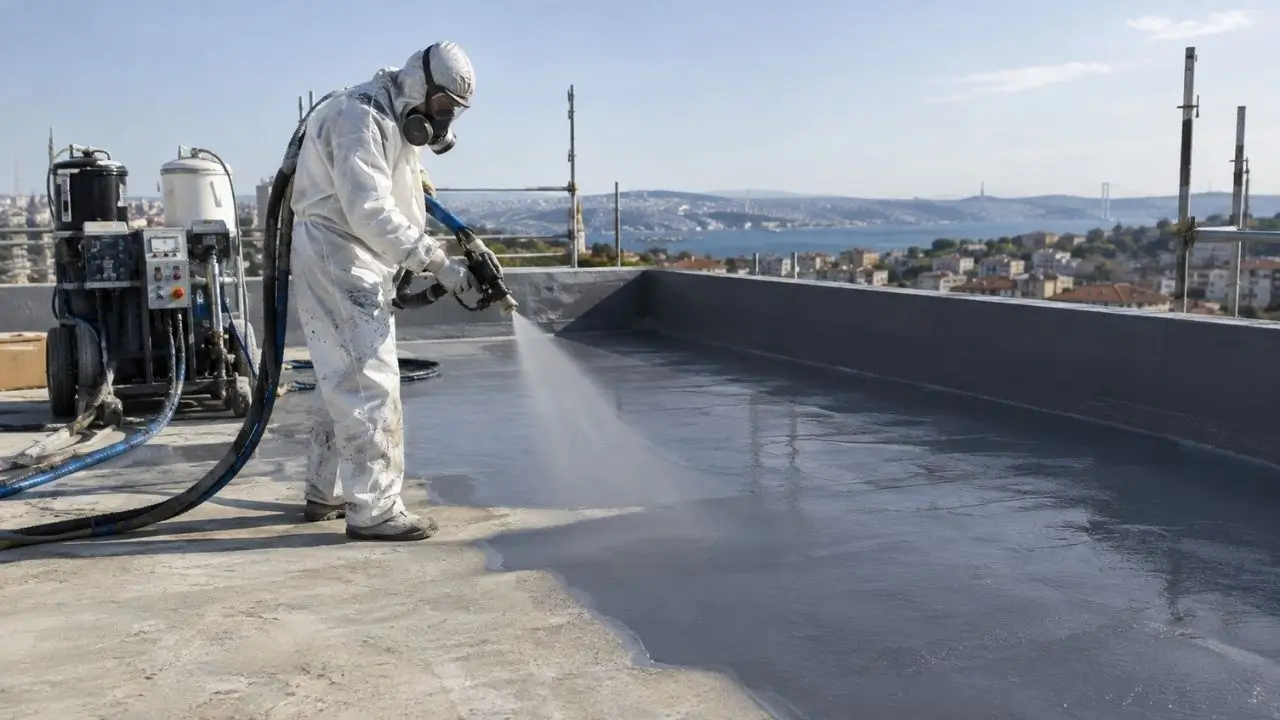
Imagine the deafening noise of a construction site, the rhythmic roar of compressors, and that faint, nose-burning chemical scent hanging in the air. Everyone is in a rush to get somewhere. Waiting is the most annoying part of construction or renovation work, especially when floor or roof insulation is involved. When working with old-school insulation materials, an entire area would be quarantined for days. You couldn't jump across it, you couldn't step on its edges, and if a breeze blew, you'd worry, "Will dust stick to it?" Polyurea is that cheeky yet overwhelmingly talented kid who bursts onto the scene right at that moment of despair, tearing up the rulebook. Watching that 80-degree hot mixture shooting from the tip of the spray gun hit the surface and solidify in mere seconds creates a strange sense of satisfaction. It’s like water turning to ice, but much more violent.
In a world where most traditional materials tell you "do not approach" for days, polyurea tells you to finish the job and leave the site with a rather arrogant attitude. The time it takes for an area to open up for use after insulation mocks our traditional perception of time. Yet, behind this speed lie certain invisible rules, chemical limits, and stages that demand respect. When the doors will fully open actually depends on what you expect from that floor.
That Second-Long Miracle: Initial Contact and Touch Drying
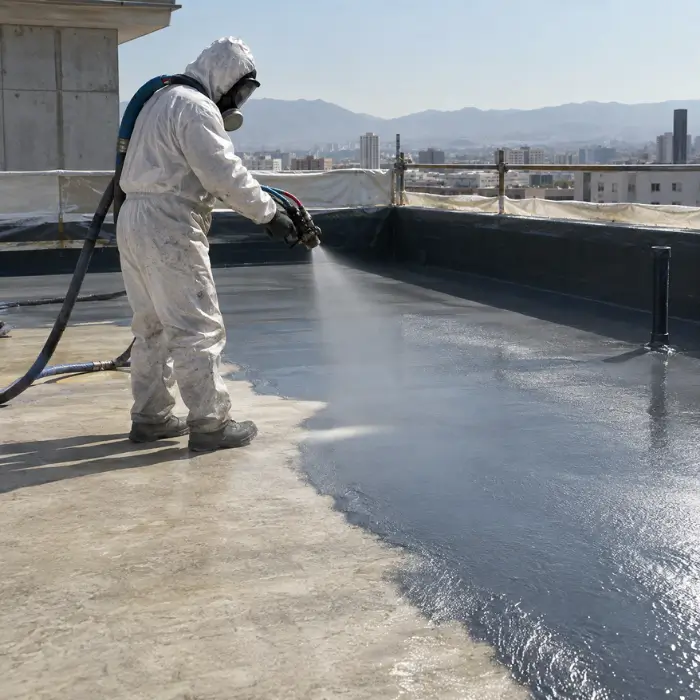
Seconds. Just three to ten seconds. I'm not exaggerating. In that tiny mixing chamber at the tip of the machine, under a terrifying pressure of 2000 psi, the colliding isocyanate and resin components float through the air, and the moment they kiss the concrete, a savage chemical reaction erupts. When you press your finger against that surface—which was liquid just a moment ago and blazing hot—you won't feel any stickiness at all. That wetness is gone, replaced by a rubbery, solid texture.
Back in the day, we would pour epoxy, pull red-and-white tape around it, and stand guard at night shouting, "Make sure no cats, dogs, or anyone steps on it." Now, the master craftsman turns off the spray gun, turns around to pour tea from his thermos, and walks away stepping right on the surface that was smoking just seconds ago. This initial phase, called surface drying, happens with such an aggressive speed that it is the sole reason the material can cling to vertical surfaces, ceilings, or sloped roofs without sagging, defying gravity. Of course, that's just the showy part of the job. In those moments when you touch it and say "it's dry," a massive chaos continues on a microscopic scale. The molecules are still busy locking together, binding their chains. The armor has been laid on the surface, but its locks haven't fully clicked shut yet.
A Tea Break Is Enough Time to Walk On It
You don't just want to poke it with a finger; you want to roam around comfortably, carry materials, or take measurements for the next phase of work. How long will you wait? About as long as a cigarette break. Roughly one to two minutes after the application finishes, the polyurea-coated area is completely open to pedestrian traffic. You can go jump on it.
But there is a very fine, often misunderstood line here. Pedestrian traffic means we are talking about human weight. I'm not talking about doing burnout stunts on the floor in spiked work boots or driving a tracked construction vehicle onto the site right then and there. Even though the floor feels like stone and a flexible shield to the touch in those moments, it hasn't yet reached its full mechanical resistance, the tear and tensile strength values written in those brochures. Remember the old polyurethane liquid-applied membranes. In the summer heat, we used to wait hours, sometimes days, for the resin to cure. A breeze would blow, and all the airborne dust and dry leaves would get stapled to that sticky surface. Let's not even talk about bugs and flies. Polyurea threw these ridiculous torments into the dusty pages of history. Imagine stopping a production line in a large factory where every second costs thousands of dollars. Waiting for days is a nightmare. However, it's not hard to understand why a system that allows walking within minutes, letting workers move on to other preparations, creates an industrial fanaticism. Walking on something that was liquid two minutes ago always gives you the feeling of cheating the laws of physics.
Heavy Loads and Liquid Contact: When Does the Real Test Begin?
When you face an impatient employer complaining, "Hey, I thought it dried in seconds, why can't I drive this vehicle in?", you need to dive a bit into the deep chemistry of the job. The hardening of the surface is one thing; polymer chains completing their cross-linking hundred percent and reaching that famous, practically indestructible form is quite another.
If the insulated space is an open-air parking deck where tons of SUVs will drive over, and tires will skid against the surface transferring the high heat of braking to the ground, you have to leave that area alone for at least 12 to 24 hours. This golden rule never bends for water tanks, giant swimming pools, or industrial concrete tanks holding acidic chemicals and wastewater either. If you pump tons of water into the tank the moment the craftsman packs up the hoses, you'll ruin the insulation. For that massive body of water to withstand hydrostatic pressure and build a wall against the corrosive effects of chemical agents, the molecular bonding must finish completely. In ideal conditions, this takes up to 24 hours. One full day. At the end of those 24 hours, that floor slips out of your control and transforms into polyurea's own kingdom. Drive any heavy vehicle you want across it, fill the tank with chlorinated water. The surface won't even flinch. But you will give it that one day, those twenty-four hours. Such a flawless technology deserves at least that much respect.
Invisible Enemies Sabotaging the Process and the Betrayal of the Subfloor
Catalogs and technical datasheets always write the cleanest, most sterile scenario of the job. Looking at those papers, the material dries in a second and a truck drives over it a minute later. But the outside world doesn't look much like the controlled environment of a laboratory. It's dirty, humid, erratic, and prone to breaking down at any moment. Polyurea doesn't suffer mortal wounds from cold or ambient humidity like other insulation chemicals. It reacts even at minus 20 degrees. Literally, this is a technological display of power.
But the tune changes abruptly when it comes to the subfloor being applied. If there is a sneaky layer of moisture trapped deep within the concrete, that ultra-trusted, beloved fast-curing process instantly turns into your worst nightmare. Why? Because polyurea seals the surface like an airtight armor in seconds. The moisture left underneath wants to vaporize and escape due to the heat, but hits that impenetrable layer above. Massive air-filled blisters erupt on the surface. You feel like popping them with a needle. A miracle that supposedly dried in 10 seconds on paper has been ruined by the concrete's wickedness.
And it's not just moisture. Spraying polyurea over an epoxy primer before it fully cures causes the two layers to become enemies, peeling off like skin over time. Polyurea's legendary self-speed of curing does not mean the application will be over in a flash. If the preparatory phase known as surface preparation—that incredibly tedious, dusty, noisy grinding and priming stage—is botched, the result is garbage, even if you spray space-shuttle coating on top. Polyurea's wild speed defying time is real. It is very fast. But for this chemical magic to work in the field, the foundation underneath must be processed with flawless patience and without rushing. The irony of this sector is that anyone who wants quick results must take the slowest steps at the very beginning.