


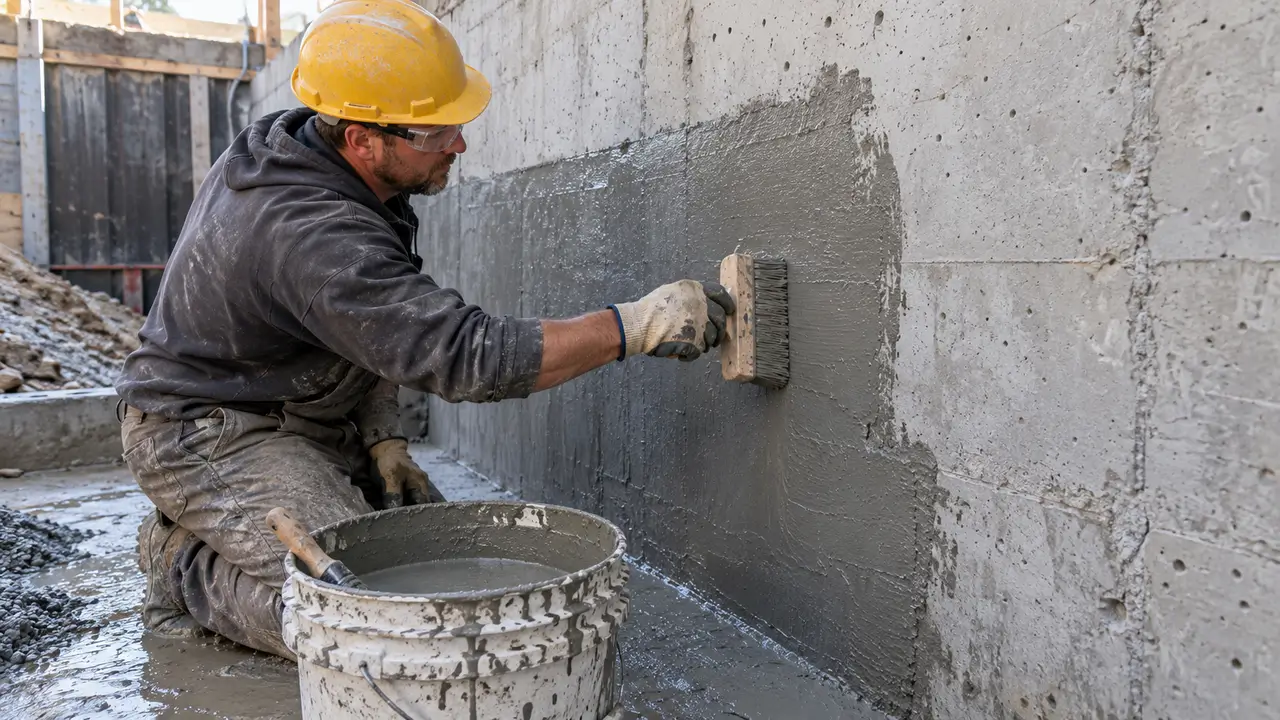
Despite its durable and strong structure, concrete is inherently a porous material. Water threatens the integrity of the structure by seeping through these microscopic capillary voids and hairline cracks. Penetrating moisture leads to corrosion in the reinforcing steel, causing the steel to expand in volume and crack the concrete from the inside out. Simultaneously, water expanding during freeze-thaw cycles fractures the concrete and severely weakens the load-bearing capacity of the structure. While externally applied surface coatings carry the risk of wearing out and puncturing over time, the construction industry has needed a more permanent approach to solve this problem at its core. Water leaks that risk structural safety cause billions of liras in repair costs.
Crystalline waterproofing is an innovative technology that transforms the material itself into a waterproof barrier rather than isolating the concrete from the outside. This system reacts with the chemistry of the concrete, permanently altering its internal structure and remaining active throughout the life of the structure. Unaffected by surface wear and applicable from both the positive (water source) and negative (opposite) sides, this technology is completely redefining the waterproofing standards of modern engineering. In this article, we will thoroughly examine the details of crystalline waterproofing technology that enables concrete to protect itself, its working mechanism, and the unique advantages it offers to the construction industry.
What is Crystalline Waterproofing?

Crystalline waterproofing is an advanced chemical system that completely blocks water by altering the natural porous structure of concrete at the molecular level. It is not an ordinary layer applied to the surface, a liquid protector applied with a roller, or an adhered membrane. On the contrary, thanks to its reactive components, it becomes an integral part of the concrete matrix, creating an integrated structure that protects the building from the inside.
The formula of this technology includes high-quality Portland cement, specially treated quartz sand, and specific active chemicals. When the mixture is applied to the concrete surface or directly added to the fresh concrete mix during the construction phase, it instantly meets the moisture inside the concrete. This encounter initiates a chain reaction that will advance into the deepest capillaries of the material, rendering the concrete completely impermeable.
Once the application is complete, the waterproofing becomes fully immune to external factors. Unlike coatings that carry the risk of tearing during backfilling, are sensitive to the sun's UV rays, or lose their elasticity over time, the crystalline structure survives as long as the concrete lives. It allows the concrete to breathe, meaning it lets internal water vapor escape, while 100% blocking the passage of liquid water.
Stop wasting time with temporary solutions against water leaks and corrosion. Turn your concrete into an impenetrable armor that heals itself the moment it contacts water with Dryfix Crystallize Waterproofing Material. Whether you add assurance to the foundation of your brand-new projects or provide flawless negative-side protection in your existing buildings. Take action now to extend the life of your structure, eliminate endless repair costs, and keep moisture away from the building forever; empower your concrete by bringing Dryfix Crystallize quality to your projects!
How Does Crystalline Technology Work?
The working principle of crystalline technology relies on using the concrete's own internal chemistry as a catalyst. When the active chemicals meet the water in the concrete's capillary voids and the free lime (calcium hydroxide) that has not fully completed its hydration, an unstoppable chemical reaction begins. As a result of this reaction, needle-like dendritic crystal networks that are absolutely insoluble in water are formed.
These millions of microscopic crystals completely fill all the capillaries, micro-cracks, and microscopic pores where water could advance. The crystals penetrate centimeters deep from the surface of the concrete, weaving an impenetrable shield. No matter how high the hydrostatic water pressure in the environment is, these crystal networks do not allow the passage of liquid at the molecular level in any way.
One of the most impressive aspects of the system is that it works with the principles of thermodynamic diffusion and osmosis. The active chemicals are continuously drawn toward the moisture-saturated areas of the concrete. Thus, the presence of water turns into a fuel that triggers crystal production rather than weakening the system. When the moisture disappears, the reaction goes dormant, but the moment water contacts the concrete again, the process immediately restarts.
Self-Healing Property
The most vital factor that makes crystalline waterproofing an engineering marvel is the concrete's self-healing ability. Buildings are not stationary, static structures; over time, new micro-cracks up to 0.4 millimeters occur in the concrete as a result of soil settlement, thermal expansion, severe winds, seismic movements, or environmental vibrations. Water tries to seep in by finding these newly opened paths under the effect of pressure.
Right at this point, the dormant active chemicals of the crystalline technology step in. These components, waiting passively in the internal structure of the concrete for years, wake up within milliseconds of contacting the water entering from the newly formed crack. Reacting again with the water and the free lime in the structure, the chemicals produce fresh crystals to flawlessly and rapidly seal the formed gap.
This continuous healing cycle is repeated endlessly throughout the entire lifespan of the structure without the need for external human intervention. Waterproofing ceases to be a static barrier and evolves into a living, constantly renewing dynamic protection system that instantly reacts to the water threat. Concrete transforms into a smart material capable of self-healing its micro-damages, securing the structure.
What Are Its Advantages Over Traditional Methods?
Choosing the right insulation system in construction projects directly determines the lifespan and permanence of the building's load-bearing system. Crystalline waterproofing completely eliminates the physical vulnerabilities carried by classic membranes, bitumen-based covers, and polyurethane liquid insulation methods. It stands out from its competitors with its absolute resistance to workmanship errors, external impacts during backfilling, and degradation over time.
In the table below, the performance and durability parameters of the high-tech crystalline system and traditional surface coating methods are compared in detail:
| Comparison Criteria | Crystalline Waterproofing | Traditional Membrane and Coating |
| Durability Lifespan | Equivalent to the life of the concrete. Never degrades. | Material fatigues, requires periodic renewal. |
| Damage Resistance | Does not tear, cannot be punctured, requires no protection concrete. | Highly susceptible to puncturing and mechanical damage. |
| Application Direction | Applied from both positive (outer) and negative (inner) sides. | Applied only from the positive side where water originates. |
| Crack Repair | Continuously self-heals cracks up to 0.4 mm. | The integrity of the insulation is instantly compromised upon cracking. |
After traditional methods are applied, they can be easily damaged during soil backfilling or when foundation rebar is tied. In the crystalline system, since the concrete itself is the waterproofing material, mechanical impacts, minor breakages, punctures, or peeling on the surface do not reduce the waterproofing performance in any way.
In Which Areas Is Crystalline Waterproofing Used?
This superior technology offers a definitive and permanent solution in the most challenging engineering projects with high hydrostatic pressure, where water attacks the structure from all directions. Its flexibility to be safely applied in almost any area where concrete is used makes it the cornerstone of the modern construction industry and infrastructure projects.
The main usage areas where water, moisture, and aggressive chemicals threaten structural integrity, making crystalline technology a mandatory requirement, are:
- Foundation Walls and Basements: Applied from the inside or outside, it reduces dampness, mold, and water leaks to zero in lower floors under constant pressure from ground water.
- Potable Water Tanks: Thanks to its non-toxic structure, it introduces no harmful chemicals into drinking water, safely and healthily insulating concrete tanks.
- Wastewater and Treatment Plants: Tremendously increases the concrete's resistance against aggressive acids, sulfates, and chloride attacks, preventing fatal corrosion in the load-bearing reinforcement.
- Elevator Shafts and Tunnels: Provides a permanent solution against intense groundwater pressure coming from the negative side in narrow spaces where external intervention is impossible.
- Swimming Pools and Dams: Prevents leaks in massive structures with continuous water contact, completely protecting the iron from the corrosive effect of chlorine.
Flexibility of Positive and Negative Side Application
One of the biggest challenges engineers face in waterproofing is the inability to intervene on the exterior facade where the water originates. In adjacent buildings within the city, deep foundation excavations, or existing buildings that subsequently take on water, reaching the outside of the foundation wall is impossible. Crystalline waterproofing radically solves this access problem with its power to be applied from the "negative side" (the dry inner surface, exactly opposite the direction the water comes from).
Active chemicals track the water and, through osmosis, move backward toward the water source in the capillary voids of the concrete. You do not need to excavate meters of soil outside to stop the water leaking from the outside of your basement; the crystalline mortar applied from the inside meets the water inside the concrete, traps it, and permanently pushes it out by turning it into crystals. This unique flexibility provides massive cost and time savings in repair projects.
When applied from the positive side (the exterior facade where water directly contacts), it forms a tremendous shield at the exact point where water first touches the concrete. Delivering the same flawless performance from both sides grants contractors and architects unmatched freedom in site conditions. Regardless of the waterproofing direction, the presence of water is the only element that triggers and enhances the system's power rather than weakening it.