


That yellow stain appearing on the downstairs neighbor's ceiling when the autumn rains begin... Believe me, this is the nightmare of anyone who has dealt with construction work even a little bit. Terraces are the most battered areas of a building, directly exposed to all the wrath of the sky. Concrete, which expands under the scorching summer heat, shrinks when temperatures drop below freezing in winter. Couple this with accumulating snowmelt, and even the smallest capillary crack turns into a water channel leaking into the building. If the right material is not chosen, all the expenses, ceramics, and efforts go to waste. Frankly, terrace waterproofing is not a matter to be left to chance or solved with a random product the local hardware store recommends as "good enough." If you don't diagnose the problem correctly and apply the right material, you'll be struggling with the exact same headache next year.
There are dozens of different waterproofing chemicals on the market. Naturally, it gets confusing. You have to start by accepting that there is no single miracle material. Will you be walking on the terrace, will ceramics be laid over it, or will the material remain exposed? What is your budget? All these questions determine the fate of the material to be used. While some products stand out with their elasticity, others dry the moment they are sprayed, saving time. My own experience with a leak on my terrace a few years ago showed me that choosing the wrong product doesn't just steal your money; it rots the building's load-bearing rebar from the inside out. For this reason, we are examining in detail the top four most effective, long-lasting waterproofing materials that have proven their performance in terrace isolation projects, complete with all their pros and cons. Let's discover together which system will perfectly suit your space.
1. Polyurethane-Based Liquid Applied Waterproofing (Liquid Membrane)
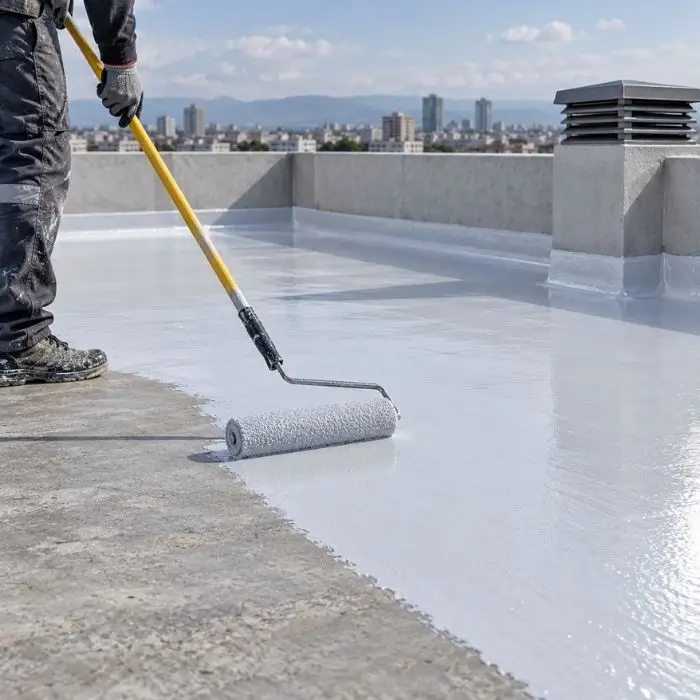
When liquid waterproofing is mentioned, the first thing that comes to contractors' minds is polyurethane resins, which are applied in liquid form and cure into a seamless rubber layer. This material possesses incredible elasticity. Its crack-bridging ability on concrete is so high that even if the underlying structure moves, it does not easily tear. Terrace joints, drain edges, or parapet returns are the main hubs for water leaks. Since polyurethane liquid membrane is applied by rolling or brushing, it features absolutely no joints. Therefore, there is no weak seam left for water to seep through. Aliphatic polyurethane must be preferred in areas directly exposed to the sun. Otherwise, aromatic variants will yellow over time due to ultraviolet rays, becoming brittle and losing their properties. The substrate must absolutely not be damp before application; otherwise, it will blister and peel off. Primer selection plays at least as critical a role as the main material itself.
The success of this material is entirely dependent on surface preparation. If you get lazy and apply it to dusty, loose, or damp concrete, you will see it bubble and blister in no time. The surface should be ground or shot-blasted, followed by a suitable epoxy or polyurethane primer. There are specific waiting times between coats. Applying the second coat before the first has dried disrupts the chemical reaction. Additionally, if you plan to place heavy garden furniture on the terrace or if it will experience heavy foot traffic, applying a protective topcoat sealer is mandatory to increase mechanical resistance. It requires somewhat meticulous workmanship, as you can see. However, when done according to the rules, it won't give you a headache for 15-20 years. In fact, transparent polyurethane variants offer immense practicality for those who want to waterproof over existing ceramics without breaking them up. This way, you can renovate your terrace without dealing with the rubble of demolition.
To summarize its advantages and application details, the characteristic features of polyurethane systems are as follows:
| Feature | Polyurethane Liquid Waterproofing |
| Application Method | Roller, brush, or airless sprayer |
| Elasticity Capacity | 400% - 600% elongation capacity |
| UV Resistance | Excellent in aliphatic types |
| Joints/Seams | Completely seamless, monolithic structure |
| Substrate Sensitivity | High (Dry and clean substrate is mandatory) |
The sweetest part of the product is that even people who could be considered amateurs can apply it using a roller, provided they use the right primers. Grabbing a brush and applying it looks like child's play. But you must not neglect to use a spiked roller to prevent air bubbles. Otherwise, micro-gases trapped between layers can pop later and create a source for leaks. While the drying time between coats shortens in hot weather, this process lengthens in the cold. Therefore, the application season must be carefully monitored.
Secure your structures for a lifetime with Dryfix polyurethane liquid waterproofing materials, which give no quarter to water leaks with their seamless and fully flexible structure. For permanent protection that defies severe weather conditions across all four seasons, choose Dryfix quality for your projects today!
2. Polyurea Coating (Sprayed Systems)
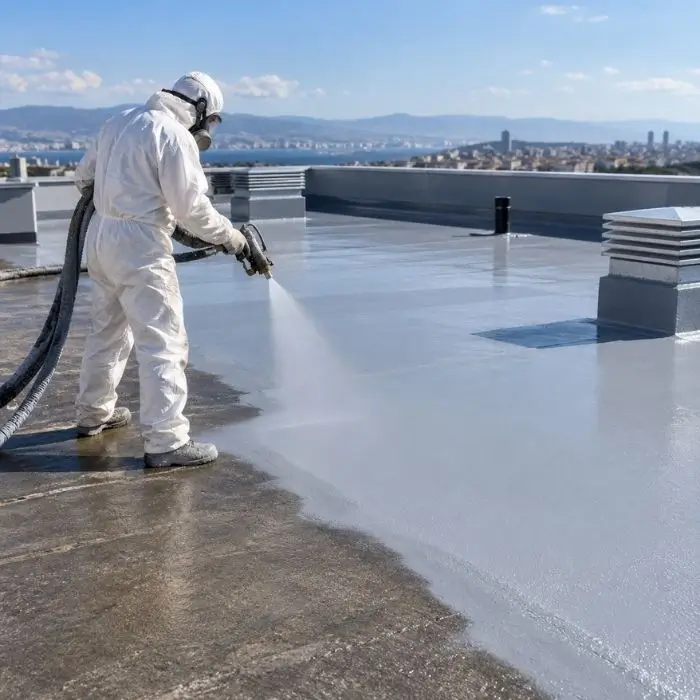
Polyurea is the ultimate haven for those seeking a rapid solution. I can call it the Formula 1 car of the insulation world. It is applied via special mobile rigs and hydraulic high-pressure reactors. It reacts the moment it is sprayed onto the surface. Hard to believe, but it cures in 5 to 10 seconds! Just minutes after the spraying is finished, you can walk on the terrace; you could even drive a car over it. Its impact resistance is so massive that it doesn't flinch if heavy equipment falls on it in a construction site environment. Its strength is high, and its flexibility is at an admirable level. It offers the opportunity to completely cover and deliver massive terrace areas of hundreds of square meters in a single day. Because of this speed, it is frequently preferred in large commercial projects. It has become the primary savior for contractors in time-sensitive terrace renovations. However, this immense speed brings with it significant equipment and expertise costs.
But everything beautiful has a price. You cannot buy it yourself and apply it to the terrace with a brush because it requires machinery worth hundreds of thousands of dollars that mixes at 70-80 degrees Celsius. The operator using the machine must also be a true expert. Skipping even the smallest area or messing up the spray gun settings leads to the weakening of the system. Then there is the issue of UV resistance. Pure polyurea systems yellow as they see the sun. They may not lose anything in terms of waterproofing performance, but they change color, ruining the aesthetics. For this reason, applying an aliphatic polyurethane-based protective topcoat or laying ceramics over it is recommended for visual appeal on open-sky terraces. Otherwise, that smooth and elegant coating can take on a rough appearance within a few months. It is of great importance not to skip this part of the job.
The steps summarizing the processes and performance of the sprayed polyurea system are as follows:
- Surface Preparation: Concrete moisture is reduced below 4%, roughened with a grinding machine, and an epoxy primer is applied.
- Hot Spraying: Reactive components are heated up to 70 degrees Celsius and sprayed homogeneously onto the surface at high pressure.
- Flash Curing: The reaction is completed in seconds, forming a millimetric, seamless, continuous layer.
- Top Protection: A UV protective topcoat layer is added to prevent color fading on exposed terraces.
If you don't have budget constraints and want to open the terrace for use quickly, it is the most technological, most robust waterproofing method you can choose. You get it done once and never look back. Even if rain, snow, or hailstorms come for years, the reinforced concrete body of your structure remains completely safe. It more than pays off the investment. The skill of the applicators and the quality of the machinery make up half the success in this system.
Make your projects completely invincible against water and impact with Dryfix polyurea waterproofing's seamless armor that cures in seconds. For an enduring, permanent, and ultra-flexible waterproofing performance that defies the years, take action now with Dryfix's advanced technology!
3. Cement-Acrylic Based Two-Component Fully Flexible Mortars
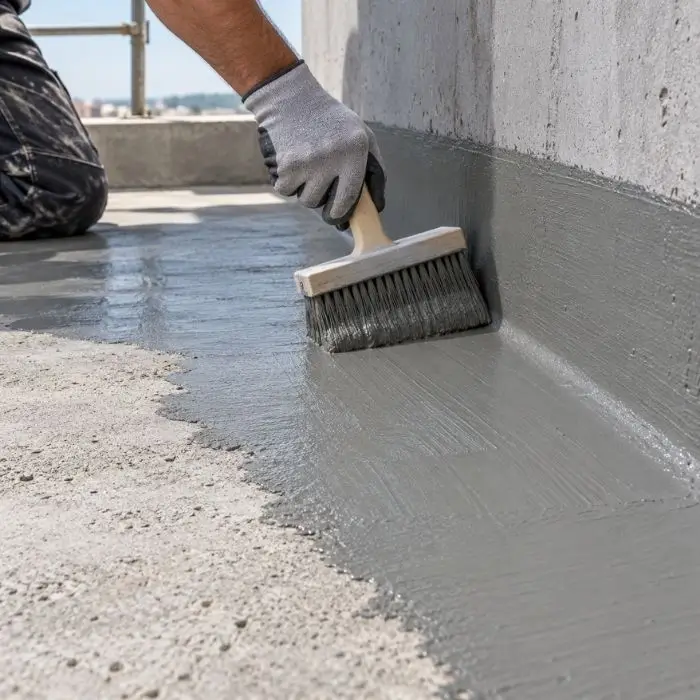
Let's move on to the market's best-selling, contractor-friendly classic solution. Obtained by mixing a bag of cement-based powder with a jerrycan of liquid acrylic polymer, these mortars blend traditional methods with modern chemistry. The excellent adhesion power of cement to concrete combines with the flexibility of acrylic. Since it offers the advantage of being applicable to wet or slightly damp substrates, it is a lifesaver in situations where you cannot wait weeks for the concrete to dry. Applying it is quite simple; it is applied in two coats at right angles to each other using a brush or trowel. It is an unrivaled option in terms of the cost-performance balance, especially in terrace waterproofing that will remain under ceramics, tiles, or porcelain. It is one of the materials most familiar to tradesmen in residential construction projects and tolerates the margin of error the most. It can be easily procured from a hardware store and the mortar prepared immediately.
However, the biggest mistake made when using this material is applying cheap "semi-flexible" products to the terrace. Because temperature differences on terraces are massive, two-component products labeled "fully flexible" or "super flexible" must absolutely be chosen. Additionally, embedding a fiberglass reinforcing mesh between the two coats prevents micro-cracks—caused by the building settling—from tearing the insulation. The mesh application directly doubles the lifespan of the terrace. Another crucial tip is to paste chamfer tape (corner detailing tape) at the corner joints. Perpendicular edges are the first places where water exerts pressure. If you do not support these areas with flexible tape, no matter what you apply, a leak from the vertical joint becomes inevitable after a while. This meticulousness paid to details ensures that the chemical power of the mortar is fully reflected in the field. The majority of application errors stem from ignoring these corner details.
Unfortunately, they are not resistant to remaining exposed. On open terraces where the sun hits at a direct angle, they must be covered with screed, ceramics, or tiles. If the cement-acrylic mortar is exposed to the sun alone, it will begin to wear out and dust away after a few winters. Therefore, it is not suitable for open areas where a coating will be applied directly over the old surface without demolition. However, if you are having your terrace rebuilt, stripping the old screed, applying this mortar with mesh to the concrete slab, and then laying new screed and ceramics over it is the most guaranteed, most economical method. It creates a solid base that you can safely use for years. For contractors and homeowners who want to achieve high waterproofing performance on a low budget, this system is an indispensable standard. When applied correctly, it won't let a single drop of water pass under the ceramics. Furthermore, since it does not contain toxic chemicals, it is environmentally and human-health friendly.
Bring your structures under full protection against the destructive effects of water with Dryfix cement-based waterproofing mortars, which combine the strength of concrete with high flexibility. To put an end to leaks permanently and add value to your project, meet Dryfix solutions today!
4. Bitumen-Based Liquid Applied Waterproofing
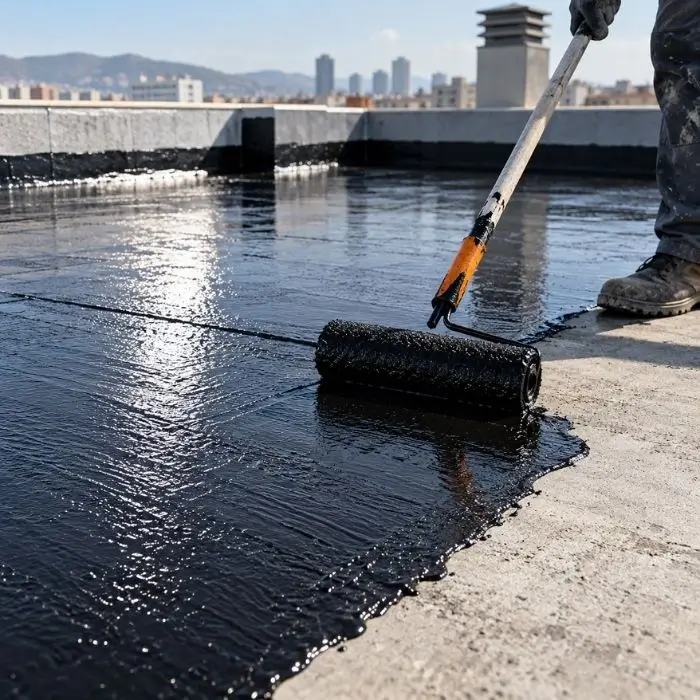
In the last spot on our list is perhaps the most veteran member of the building sector: Bitumen-based liquid materials. This is the modern version of the material we colloquially call "pitch" or "tar," modified with rubber, polymers, and synthetic resins. It is black in color. There are water-soluble liquid forms as well as solvent-based ones available. It adheres perfectly to concrete and cures rapidly to create an impermeable, thick layer of bitumen. From a price perspective, it is quite wallet-friendly compared to all other chemicals. It is tailor-made for those who want to achieve a thick insulation layer on expansive terrace surfaces without breaking the budget. Since it has been used in roof and basement waterproofing for years, there is hardly a contractor who doesn't know its application logic. However, it should not be forgotten that it can melt under the sun if not detailed correctly. Therefore, choosing the right application area is mandatory.
Bitumen's biggest weakness is sunlight. Ultraviolet radiation breaks down the structure of bitumen; the material stiffens over time, loses its elasticity, and begins to fracture and crack. Therefore, bitumen-based liquid applied materials can absolutely never be left exposed on a terrace. A protective screed must definitely be poured over it, or it must be covered with earth/gravel. They are generally used under a protective layer, as an under-screed waterproofing material. Additionally, since they tend to soften in hot weather, the screed to be poured or the protective sheet to be placed over them must not damage the insulation layer. When it remains under soil or screed with the right detailing, it offers trouble-free performance for many years. In short, if your budget is limited and you are definitely going to pour screed and lay ceramics on the terrace, bitumen-based liquid waterproofing can come to your rescue. Otherwise, it will be much wiser to turn to other alternatives for exposed terrace applications.
Fully armor your structure against moisture and leaks with the strong adhesion capability and continuous impermeability of Dryfix bitumen-based liquid waterproofing. To achieve budget-friendly, long-lasting protection on terraces and structures, explore Dryfix solutions today!