


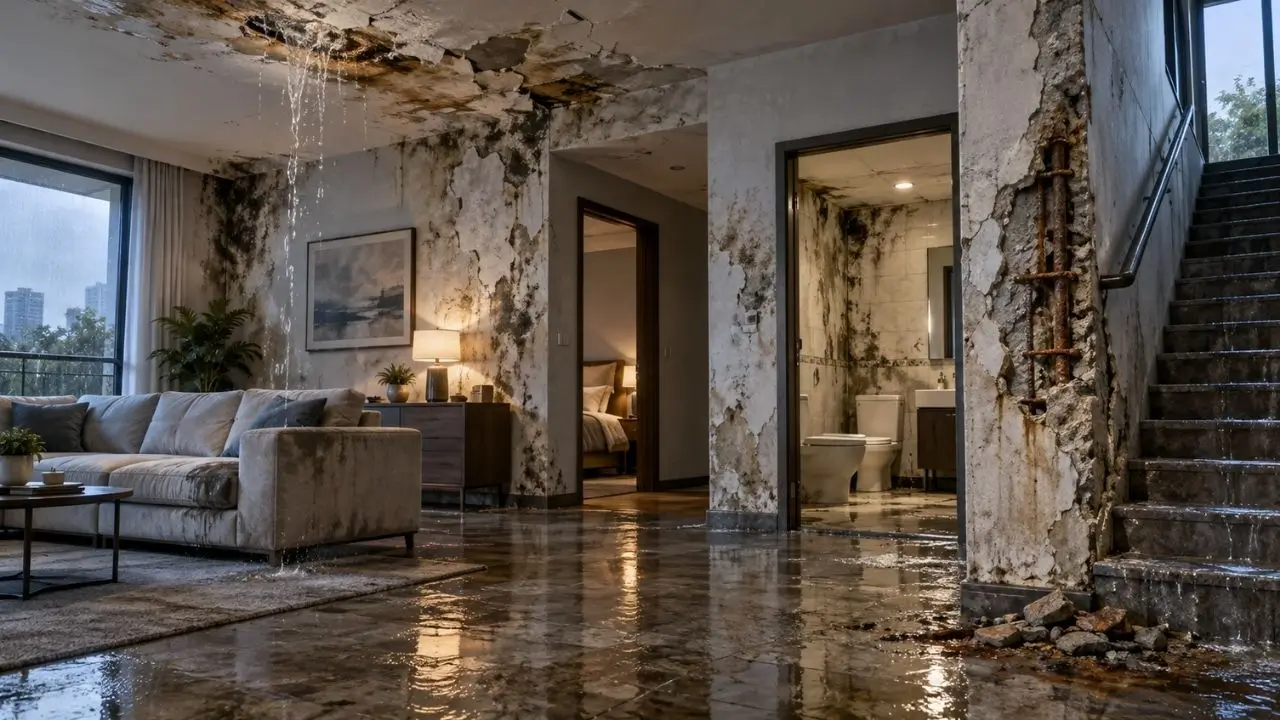
Water doesn't just take the shape of its container; it rewrites the destiny of the structure it enters. Behind those smooth, glamorous facades and flashy buildings, it is hard to imagine the devastation caused by a single drop of water silently seeping through microscopic cracks. Remember that paper-thin insulation layer ignored to cut costs on a few items during construction? That exact omission turns into an insidious disease that gnaws away at a massive concrete block from the inside years later. It feels illogical to think how a drop of water can melt concrete. We are talking about steel and cement. Yet, you are fighting the most stubborn element of nature. You have no chance of winning. Even rocks shatter against the patience of water, making it impossible for a man-made building to stand tall without staying dry.
That small, innocent yellow stain appearing on your house's wall is actually the most concrete manifestation of ringing alarm bells. The paint is blistering. The plaster is crumbling. Your downstairs neighbor keeps complaining about the darkening on their ceiling. These seem like mere cosmetic troubles; giving the illusion that they can be solved with a can of primer and some ceiling paint from a hardware store. You pour some bleach on a cloth and wipe away that mold. The reality of the matter is entirely different. That yellow stain is the outward projection of the reinforcing steel, which carries tons of weight, silently rotting in the dark, and the concrete literally agonizing. A building without waterproofing is no different from a diseased organism with a completely collapsed immune system; it suffers irreversible wounds at the slightest tremor or harsh seasonal transition.
The Danger of Corrosion and Decay in the Building's Structural System

Iron, by its very nature, is hungry for air and moisture. The steel reinforcements trapped within that gray, cold mass of concrete begin to rust—or undergo corrosion in engineering terms—the moment they encounter water. It’s not just the color of the iron that changes. Rust. It is a highly insidious reaction. Corroded iron swells. Expanding to many times its original diameter, it exerts immense, uncalculated pressure from the inside onto the surrounding concrete. That thick concrete shell you thought unbreakable cannot withstand this internal pressure and shatters. The outer layer, what we call the concrete cover, begins to spall.
Think about it. The skeleton keeping the building upright is trying to break out by tearing through its own flesh. If you can see those rusty irons at the corners of the columns with your own eyes, it is already too late.
Once corrosion begins, the load-bearing capacity of the iron melts away rapidly. That rock-solid, ribbed rebar cast years ago with a 16-millimeter diameter turns into a consistency that crumbles between your fingers once it falls into the trap of seeping water. The thickness drops to 12 millimeters, then down to 10 millimeters. Moreover, because those ribs melt away, the iron begins to slip inside the concrete. That sacred bond between concrete and iron is broken. When the structural system forming a building's spine weakens like this, it becomes a miracle for the building to carry even the wind load, let alone not crush under its own weight.
Degradation of Concrete Structure and Crack Formation
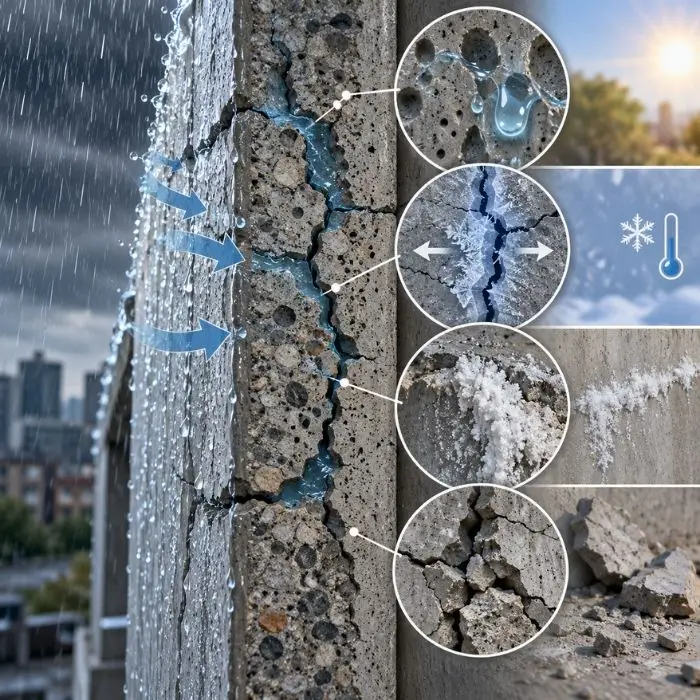
Concrete breathes. It is like a sponge; the capillary voids within its structure literally lie in wait to absorb outside water. Water seeping through an uninsulated surface reacts with the chemical structure of the concrete. As the cement paste gets washed away by water, it loses its binding properties. The most ruthless part of the process begins in the winter months. Water has a habit of expanding its volume when it freezes. Water that has seeped into concrete turns to ice at sub-zero temperatures and blows up those microscopic voids from the inside like dynamite.
The stages of this destructive cycle are very clear and, unless stopped, feed off themselves:
- Capillary Absorption and Saturation: Surface waters, rain, or acidic groundwater seep silently through the pores of the concrete. It goes unnoticed by the naked eye. The concrete drinks the water to its fill.
- Freeze-Thaw Cycle: Water freezes at night, its volume increases, and it tears the inner walls of the concrete. It melts during the day, descending even deeper through the brand new and wider cracks that have opened up. This cycle repeats thousands of times every winter.
- Efflorescence and Salt Leaching: Water dissolves the free lime inside the concrete and carries it to the surface. Those white, cottony, raised stains we see on walls are actually the concrete melting and flowing out. The very marrow and bones of the structure are being drained.
- Irreversible Disintegration: Micro-cracks merge. They turn into macro-cracks. The concrete has now lost its integrity, evolving into a pile of sand ready to scatter when struck with a hammer.
The Crucial Relationship Between Waterproofing and Earthquake Resistance

People assume buildings collapse merely because they shake violently during an earthquake. That is not entirely true. Buildings collapse because they have lost the flexibility and strength to withstand that tremor over the years. A foundation without waterproofing directly absorbs the sulfate, chloride, and moisture from the soil. This situation silently destroys the resistance at the connection joints of columns and shear walls. The chances of a building whose foundation floats in water surviving an earthquake undamaged are zero.
The picture we have seen in bitter experiences was always the same. The columns of buildings that looked perfectly solid from the outside crumbled to dust with a minor tremor. A lack of insulation is the biggest accomplice that secretly magnifies the impact of an earthquake.
| Condition | Rebar (Iron) Condition | Concrete Cross-Sectional Area | Expected Response During an Earthquake |
| Properly Waterproofed Foundation | Zero corrosion, steel maintains its flexibility. | At original project dimensions, no loss. | Absorbs seismic energy, flexes, does not collapse even if damaged. |
| Unwaterproofed Foundation (First 5 Years) | Onset of pitting corrosion on the surface. | Micro-cracks begin, efflorescence is observed. | 10-15% loss in load-bearing capacity. Flexes more than expected. |
| Unwaterproofed Foundation (15+ Years) | Severe reduction in diameter, heavy corrosion, loss of adherence. | Concrete cover has spalled, concrete has become spongy. | Brittle fracture occurs. Structural system cannot withstand the tremor; the building collapses instantly. |
A column exposed to water has absolutely nothing to do with that durable column drawn in the project years ago anymore. It has practically turned into a paper tiger.
Why Does a Building's Lifespan End Much Earlier Than Expected?
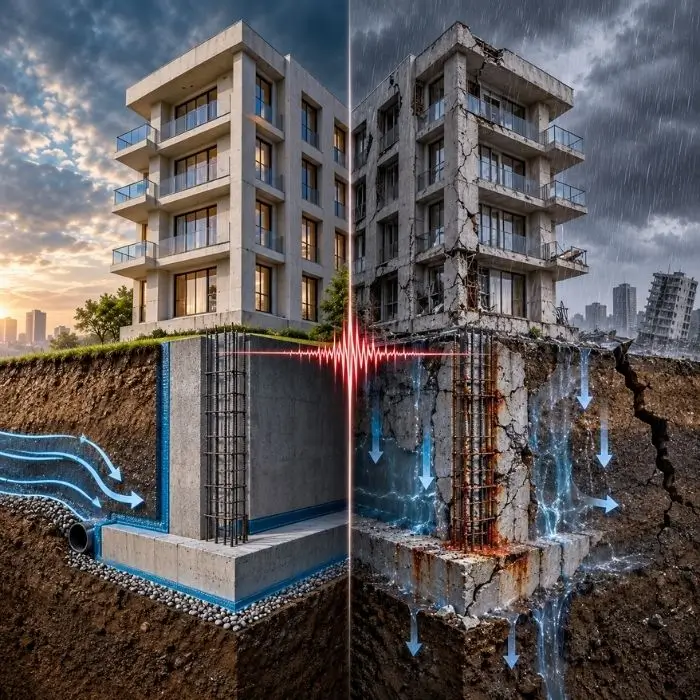
The economic lifespan of a reinforced concrete structure calculated on paper is fifty, sixty, sometimes eighty years. This duration is predicted by looking at the grade of the concrete poured and the quality of the iron used when laying the foundation. When a lack of waterproofing and water infiltration enter the picture, those flashy numbers hold no weight at all. Between groundwater seeping from the foundation and melting snow leaking through the roof, the building multiplies its aging speed by four or five. The devastation of water spreads like a cancer cell.
For those living inside, the process is an endless, nerve-wracking spiral of renovations.
One month you scrape the wall and repaint it. The next month, your brand new parquet floors blister. You completely overhaul the roof, only to realize that rainwater driven by the wind from the north facade has leaked inside. A constant rush to repair things, never-ending bills. Yet the building is now exhausted at a cellular level. When the decay of the structural system is combined with the deterioration of the concrete's chemistry, the fatigue life of the building shortens dramatically. Those luxury apartments sold by contractors as "heirloom properties" end up in line for column retrofitting or urban renewal before they even see their thirtieth year. Because water doesn't just rot the structure it enters. It ages it from the inside out, exhausts it, and ultimately kills it. Skipping a few rolls of membrane or liquid waterproofing from the foundation or roof to save money paves the way for the premature demise of a massive fortune and, even more tragically, the lives within that fortune. Water has a memory; it never forgets a crack it has found.
Put an end to that insidious persistence of water gnawing at structures, not with ordinary patches, but with Dryfix's high-tech insulation armor. With these formulas creating a flawless shield from foundation to roof, let your buildings stand alone and defy harsh seasons and years. Choose Dryfix assurance right now to wake up from endless renovation nightmares and permanently seal your project.