


Water always finds a way. Sometimes it appears as a sneaky leak behind kitchen cabinets, other times as a yellowed, ever-expanding ugly map on the living room ceiling. Years ago, while inspecting the condition of rebars on a construction site, I learned very early on not to be fooled by the massive, invincible stance of concrete. That hard, cold gray mass is actually no different from a giant sponge filled with invisible capillary voids. The moment it draws water in, the iron reinforcement begins to rust, and the structure silently starts rotting from the inside. This is exactly where cement-based waterproofing materials come into play. The idea of defending concrete with its own weapon—the mineral and robust nature of cement itself—has always struck me as a brilliant strategy.
Instead of covering the surface with foreign materials, laying down nylon, or applying pitch, these mortars that directly adapt to the structure's chemistry are preferred. Why? Because they create a monolithic shield that integrates seamlessly with the concrete. Keeping water out easily extends the lifespan of a building by decades. I have seen with my own eyes how master builders, having witnessed plastic-based membranes shrink, peel, and tear under the sun, cling tightly to cementitious brush-applied products. It penetrates deep into the surface. It provides flawless adhesion. It leaves no gaps behind. So, in which areas should we build this shield? The answer to this question covers many vital points, starting from the darkest foundation of the building all the way up to its roof reaching for the sky.
Indoor Wet Areas

Think of your bathroom floor. Every morning while taking a shower, the invisible water vapors seeping under those ceramics look for paths through capillary cracks. Ceramic or tile alone cannot stop water. It is merely an aesthetic cover. The moment you fail to apply an elastic cement-based layer over the underlying concrete screed, those infamous blisters start appearing on your downstairs neighbor's ceiling. The secret lies in the invisible layer beneath that cover.
Those blind spots where kitchen counters meet the wall, and the drain edges in toilets are absolute hotbeds for leaks. You cannot leave things to chance here. You have to grab a brush and feed that gray, thick cementitious mortar into the corner joints. The secret is hidden in the material bonding to the concrete at a molecular level. Water drops cannot breach this barrier and are forced into a mandatory direction toward the drain. They have nowhere else to go.
It is no coincidence that masters prefer two-component products in these areas. The liquid polymer added to the mix gives the mortar a rubbery elasticity. When the building settles slightly or flexes during a minor tremor, that insulation layer moves with the structure without tearing. In indoor spaces where water looks for the slightest weakness, this elasticity is a lifesaver. The cost of breaking the cladding to redo the waterproofing is exponentially higher than taking precautions from the start.
To protect your living spaces from the destructive effects of water, Dryfix cement-based waterproofing materials serve as a perfect shield. With these superior formulated products, you can transform your bathrooms and kitchens into safe zones that do not cause leak nightmares for the floors below. Explore the durability-tested Dryfix solutions now and choose the most suitable protection for your project.
Water Tanks and Swimming Pools

We are talking about the mind-boggling hydrostatic pressure created by tons of water. Imagine standing at the bottom of a swimming pool. The sheer weight of the water alone is enough to crack concrete and carve out thin leakage paths. In tanks, human health also comes into play. You cannot use materials that leach toxic chemicals in drinking water tanks. Cement-based brush-applied insulation is unrivaled here. They penetrate the concrete so deeply that they plug the capillary voids by producing crystals. I am talking about a structure that reacts with water itself and becomes even harder. Incredible, isn't it?
| Area of Use | Main Challenge Encountered | Advantage Provided by Cement-Based Solution |
| Drinking Water Tanks | Obligation to maintain hygiene standards | Mineral structure that is insoluble in water and contains no toxic substances |
| Outdoor Swimming Pools | Continuous chlorine and chemical contact | Hard floor, resistant to corrosion and compatible under ceramics |
| Thermal Pools | Sudden expansions caused by hot water | Superior resistance to cracking with its fully elastic structure |
As you can see in the table, every body of water brings its own unique troubles. Keeping the water inside is not enough. The structure must also be protected from the chlorine and sulfate in the water. Two or three coats of cement-based waterproofing applied before laying the pool tiles add years to the concrete's life. This is exactly the invisible hero behind those blue ceramics. A silent guardian resisting continuous pressure.
Foundations, Basements, and Retaining Walls

Underground is dark, damp, and unforgiving. The moment you build a structure and cover its surroundings with soil, you are left alone with groundwater. If the foundations and retaining walls cannot resist this sneaky moisture coming from the soil, buildings literally start rotting from their feet up. You know that throat-burning smell of mold in basements. That smell is the cry of waterproofing that was either not done in time or done incorrectly. The crystallized versions of cement-based products work almost like magic in this deep darkness. They produce crystals that advance deeper into the concrete whenever exposed to water.
- Negative Side Intervention: It comes to the rescue in situations where the source of the leak cannot be reached from the outside. Applied from the opposite direction of the water flow—meaning from inside the building—it traps the water within the concrete cross-section.
- Stopping Active Water Leaks: There are special flash-setting cement mortars. Even pressurized, gushing water can be cut off in seconds with these plugs.
- Rebar Protection: By blocking the moisture seeping into the concrete, it stops the iron from rusting. The iron does not rust and expand in volume, preventing the concrete from spalling.
The key to turning your basement into a livable space, a dry warehouse, or a solid parking garage is these earth-touching surfaces. Watching the sky from under the roof of a building without a solid foundation is only temporary peace.
Terraces and Balconies
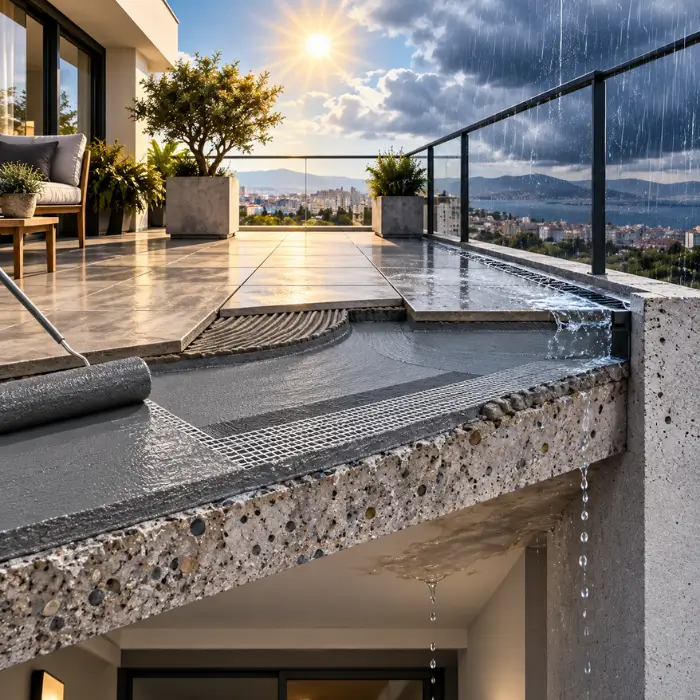
Protecting those large areas that bake under the scorching sun and freeze in the winter frost is one of civil engineering's most frustrating tests. Terraces are in constant motion. Temperature differences cause the concrete to almost breathe, expanding and contracting at a microscopic level. If you apply a rigid material here—one that hardens like stone and does not flex—massive cracks will appear by the end of the first winter. Rainwater dripping from the living room ceiling downstairs will annoy you quite a bit. Moreover, those water drops accumulating on your furniture are enough to wear your nerves down.
Cement-based but "fully elastic" class waterproofing mortars are designed to absorb this stress. Those with high UV resistance can be left exposed, or it is possible to pour a screed over them and apply ceramic tiles. Let's say you are going to place giant pots with plants on your balcony. The water that leaks as you water those plants, and the organic acids dropping from the leaves slowly erode the floor. This shield, a mixture of cement and acrylic resin, draws a firm line against water passing under the screed and dissolving the reinforced concrete slab. When applied with mesh reinforcement, its tear resistance reaches incredible dimensions. Furthermore, since they belong to the same family as ceramic adhesives, they hold the cladding tightly. They never peel off.
Elevator Pits and Retaining Walls

Have you ever had the chance to go down into an elevator shaft? Those deep, narrow, claustrophobic pits are right in the crosshairs of the groundwater table. Because they are the lowest point of the building, surrounding water fills up here like a funnel. The water accumulating inside the pit does not just create a bad odor. It rapidly oxidizes the mechanical parts, ropes, and rails of the elevator. Can you imagine the scale of the danger? Going meters up inside a metal box with rusted rails is an experience nobody would want. Excavating from the outside in such a tight space to apply waterproofing is impossible. Interventions made from inside the pit with cement-based crystallized insulation mortars cut off the water permanently.
Retaining walls experience a similar drama. The water held by the massive mass of soil piled behind it puts incredible pressure on the wall. Stopping the water trickling down like teardrops is the first step in preventing that wall from collapsing. Cementitious products resistant to negative water pressure preserve the load-bearing capacity of these vertical barriers and eliminate the mossy, ugly concrete appearance. They create solid, dry, safe walls. They silently shoulder the tons of soil hidden behind them.
Infrastructure and Engineering Structures

The veins of a metropolis run underground. Drinking water transmission lines stretching for kilometers, colossal tunnels piercing through mountains, giant bridge piers defying rivers... The war engineering structures wage against water is an epic struggle. Unlike ordinary buildings, the problems created by leaks are not limited to aesthetics or small-scale damage. Concrete crumbling by absorbing water at the bottom of a dam gate or in a hydroelectric power plant means disaster. In these mega-projects, the number one line of defense protecting concrete from external factors, sulfate attacks, chloride ions, and freeze-thaw cycles is cement-based waterproofing systems. This is the fiercest front in the fight against water.
De-icing salts sprinkled on the roads in winter trickle down to the viaduct piers along with melting snow. Salty water dissolves the reinforcement inside the concrete. When flexible, polymer-modified cement mortars with crack-bridging capabilities are applied to these piers, an invisible armor is worn around the concrete. Water passes. Salt stays. This is a tremendous armor produced by humans against the corrosive forces of nature, inspired again by the minerals in nature. Refusing to leave the lifespan of a structure to the mercy of nature is only possible through this chemical integration. The victory of cement against water lies exactly here.